FLGR-242: $49.90 per mg, Review and Discount Code
FLGR-242 lists at $499.00 for a 10 mg pair, which is $49.90 per mg. The per-mg maths, the activin contradiction on the vendor page, and the code.
MEDICAL DISCLAIMER: Educational research guidelines only. Lyophilized peptides are investigational chemical compounds and are NOT approved for human consumption, diagnosis, or therapy. Consult a licensed physician before any research application.
FLGR-242 is sold in pairs, and a pair is two 5 mg vials, so the smallest unit anyone buys is 10 mg at a list price of $499.00. Divide, and the figure this page is built on appears: $49.90 per milligram, at list, checked 2026-09-08. No competing page states it, which is strange, because cost per mg is the only price figure that survives a change of vial or pack size.
The bulk ladder moves that number, and not by much. Six pairs takes 5 percent off, twelve takes 10, twenty four takes 15, and the largest pack, 48 pairs at $19,161.60, takes 20. Worked through, the floor is $39.92 per mg. The whole volume structure, from one pair to 480 mg and a five figure invoice, is worth $9.98 per mg.
Three things on that listing are unresolved, and each bears on whether a per-mg figure means anything. The page contradicts itself about activin, three times. The certificate of analysis is advertised in the product title and absent from the public library. The name returns nothing on PubMed and nothing on ClinicalTrials.gov.
The price this page divides
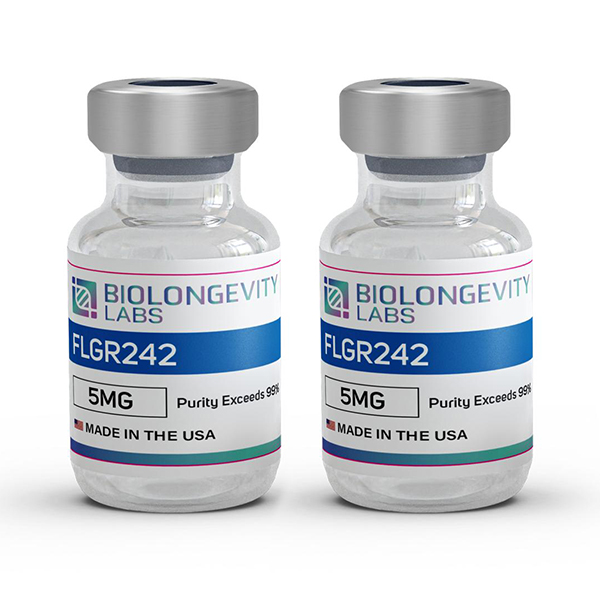
FLGR-242 (vendor spelling FLGR242), Bio Longevity Labs
One pair is two 5 mg vials, 10 mg in total. At the $499.00 list price that is $49.90 per mg.
The code Peptidedeck is entered at checkout. We have not verified what it returns, so this page states no percentage and does its arithmetic on the $499.00 list price only. A sitewide sale banner was also running on the day of the check, and banners are temporary in a way an article is not.
- Sold as pairs: 2 vials, 10 mg total
- Volume tiers at 6, 12, 24 and 48 pairs
- List price and tiers checked 2026-09-08
Laboratory research material only, not for human consumption. FLGR-242 holds no marketing authorisation in any market and has never been tested in a human trial. Affiliate links: we may earn a commission at no additional cost to you.
What FLGR-242 is, and why "peptide" is the wrong word for it
The vendor spells it FLGR242, no hyphen, and sells it as FLGR242 5mg Research Peptide. Search demand splits across FLGR-242, FLGR 242 and FLGR242, and all three name the same listing.
The description is worth reading slowly:
FLGR242 is a novel fragmented, modified version of Follistatin-344 (FST-344) that does not bind to the protein activin. [...] It also contains a patented albumin binder. Follistatin protein (FST) fused with an albumin-binding construct that uses a hydrophilic glycine-serine linker to achieve high-affinity binding to serum albumin (<20 nM Kd).
A short synthetic peptide is a chain of amino acids assembled on a resin, weighing perhaps one to four kilodaltons. This is a recombinant glycoprotein of roughly 40 kDa with a fusion partner attached to it. Different molecule, different manufacturing route, different everything. The word "peptide" in the product title covers that over.
| Vendor-stated property | Value | Checkable before you pay? |
|---|---|---|
| Type | Follistatin albumin binding construct | No |
| Linker | GGSGGSGGSGGRLIEDICLPRWGCLWEDD | No |
| Molecular weight | About 40 kDa | No |
| Albumin binding affinity | Under 20 nM Kd | No |
| Synonyms given | FST-Albumin Construct, Extended Half-Life Follistatin | Not applicable |
| Vial and pack | 5 mg vial, sold as pairs of two vials, 10 mg | Yes, stated on the listing |
| Manufacturing | US GMP, third-party verified | No, see below |
Every No in that column has one cause, and the COA section below is it.
FLGR-242 vs follistatin-344, and what a mg is not
FLGR-242 is a product name, not a molecule name. It derives from follistatin-344, and the vendor says plainly that it is fragmented, modified and fused to an albumin binder. Three modifications away from the parent is not the parent.
That costs a buyer twice. In evidence, because follistatin literature is not literature about this construct, which the research section below sets out. And in arithmetic, because cost per mg divides money by mass, and mass is not molecules. A milligram of a 40 kDa construct holds roughly a tenth as many molecules as a milligram of a 4 kDa peptide, each molecule being about ten times heavier. Set $49.90 per mg beside the per-mg price of a short synthetic peptide and you compare what a gram costs to make, not what a molecule costs to buy: legitimate inside a class, misleading across classes, and most per-mg tables in this market cross classes without saying so.
The vendor page contradicts itself about activin, three times
On one product page, in three places, the seller says three incompatible things.
The product description states that FLGR242 "does not bind to the protein activin". The meta description and social card for the same page state that it is "Studied for myostatin inhibition and activin binding". The research applications section on the same page lists "activin neutralisation assays".
This is not a copywriting nitpick. Follistatin's established mechanism is high-affinity binding and neutralisation of activins and related TGF-beta ligands. A construct that genuinely did not bind activin would be a substantially different molecule from the one the rest of the page describes, and the same page sells it for activin neutralisation assays, a use that requires the binding the description denies.
A buyer cannot resolve this from the listing. Either the description is wrong or the meta and the applications are, and the contradiction sits on the one property that decides whether the material does anything in an assay. Ask in writing before ordering.
"COA included", and what the public library actually holds
The product title says COA Included. The description promises comprehensive COAs. So we opened the library.
The public COA page at biolongevitylabs.com/all-coas/ held eight PDFs on 2026-09-08, and not one of them covers follistatin or FLGR-242. They are a Cortagen certificate and endotoxin reports for BPC-157 with TB-500, CJC-1295 with ipamorelin, DSIP, retatrutide, SS-31 and tesamorelin. Seven other compounds, and nothing for the one on this page.
A certificate that appears only after purchase cannot inform the purchase, which is the only moment it has leverage. It is also why every row of the properties table says No: molecular weight, purity, identity and endotoxin are all measurements, all reportable on one page, and none are published here. Until one is, the 40 kDa figure and the sub 20 nM Kd are claims about a molecule rather than results from a batch.
It matters more for a recombinant protein than a synthetic peptide: expression in cells brings host-cell impurities and endotoxin risk that solid-phase synthesis does not, which is why those endotoxin reports exist for the other products.
FLGR-242 research: zero results, twice
PubMed returns 0 results for FLGR-242 and 0 for FLGR242. ClinicalTrials.gov returns 0 records. There is no independent literature on this construct at all: no trial, no case series, no third-party characterisation.
The listing carries twelve citations and we checked a sample. They are real papers. Systemic administration of follistatin288 increases muscle mass is PMID 23942549, 2013, mice. Nanoparticle-mediated hepatic delivery of follistatin mRNA is PMID 30555546, 2018, mice. Follistatin in NAFLD via mTOR is PMID 36325432, 2022.
Every one studies follistatin. None studied FLGR-242. This is how a proprietary construct borrows the evidence base of the family it derives from: the citations are genuine, the compound in them is not the compound on sale, and the bibliography persuades without making a claim anyone could check.
The honest summary is short. There is animal literature on follistatin. There is no literature on this construct, no human data of any kind, and no marketing authorisation anywhere.
The bulk ladder, and where the per-mg floor sits
Volume tiers are stated on the listing: 5 percent at six pairs, 10 at twelve, 15 at twenty four, 20 at forty eight. Each pair is 10 mg, so the ladder in per-mg terms, all of it derived from the $499.00 list price checked 2026-09-08, looks like this.
| Order | Vials | Total mass | Cost at list | Cost per mg |
|---|---|---|---|---|
| 1 pair | 2 | 10 mg | $499.00 | $49.90 |
| 6 pairs, 5 percent tier | 12 | 60 mg | $2,844.30 | $47.41 |
| 12 pairs, 10 percent tier | 24 | 120 mg | $5,389.20 | $44.91 |
| 24 pairs, 15 percent tier | 48 | 240 mg | $10,179.60 | $42.42 |
| 48 pairs, 20 percent tier | 96 | 480 mg | $19,161.60 | $39.92 |
Two of those per-mg figures round to the nearest cent, from $47.405 and $42.415. The rest are exact.
The bottom row checks the rest: the vendor states $19,161.60 for the 48 pair pack, and 48 times $499.00 less 20 percent is $19,161.60 to the cent. The ladder is arithmetically what it says.
What it buys is $9.98 per mg in exchange for spending $18,662.60 more in one transaction, on material whose certificate you will not have seen. The ladder rewards committing to 480 mg of an unpublished construct at once, which is a risk transfer more than a saving.
What $49.90 per mg cannot tell you
Cost per mg is exact and narrow. It ranks packs of the same material honestly, it is immune to pack-size marketing, and it took one division.
It divides by the labelled mass, and a label is a claim rather than a measurement until a certificate tests it. A seller who overstates a label wins on this metric while shipping nothing extra, and here that caveat is unusually live, because no certificate for this product is published. The metric is also silent on purity, on endotoxin, on whether the construct binds activin or does not, and on whether any of it does anything, in anything, ever. Those are questions for an assay and a trial, and division cannot reach them.
The fair summary is two sentences. FLGR-242 costs $49.90 per mg at list and $39.92 per mg at the deepest tier, checked 2026-09-08. What that buys is a molecule whose seller cannot keep its story straight about activin, whose certificate is advertised and unpublished, and whose name appears nowhere in the literature.
Frequently Asked Questions
How much does FLGR-242 cost per mg?expand_more
A pair is two 5 mg vials, so 10 mg, listed at $499.00. That is $49.90 per mg, checked 2026-09-08. The volume ladder takes it down to $39.92 per mg at the 48 pair tier, which is $19,161.60 for 480 mg.
Is there an FLGR-242 discount code?expand_more
The code is Peptidedeck, entered at checkout. We have not verified what it returns, so we quote no percentage and calculate every figure here from the $499.00 list price instead.
What is the FLGR-242 dosage?expand_more
We publish none. There is no human data on this construct, no published protocol, and no certificate of analysis in the vendor's public library to confirm what is in a vial. This page deals only in cost per milligram.
Is FLGR-242 the same as follistatin-344?expand_more
No. The vendor calls it a fragmented, modified version of follistatin-344 fused to an albumin binder, a construct of roughly 40 kDa. It derives from follistatin-344 and is not it, which is why follistatin papers are not evidence about it.
Does FLGR-242 come with a COA?expand_more
The title says COA Included, but the vendor's public library held eight PDFs when we checked and none covered follistatin or FLGR-242. They cover Cortagen, BPC-157 with TB-500, CJC-1295 with ipamorelin, DSIP, retatrutide, SS-31 and tesamorelin. A certificate you can only see after buying cannot inform the decision to buy.
References & Citations
- [1]
Systemic administration of follistatin288 increases muscle mass. 2013. Mouse study. Cited by the vendor for FLGR-242; the study itself concerns follistatin, not FLGR-242.View source →
- [2]
Nanoparticle-mediated hepatic delivery of follistatin mRNA. 2018. Mouse study. Cited by the vendor for FLGR-242; the study itself concerns follistatin, not FLGR-242.View source →
- [3]
Follistatin in non-alcoholic fatty liver disease, acting via mTOR. 2022. Cited by the vendor for FLGR-242; the study itself concerns follistatin, not FLGR-242.View source →