Weight Loss Injections: Dosing Schedules, Syringe Units and How Escalation Works
A dosing-first guide to weight loss injections: which compounds are injected weekly or daily, how milligram doses convert to insulin syringe units, why doses escalate, and what to check before the first injection.
MEDICAL DISCLAIMER: Educational research guidelines only. Lyophilized peptides are investigational chemical compounds and are NOT approved for human consumption, diagnosis, or therapy. Consult a licensed physician before any research application.
Weight loss injections are usually discussed as products. They are better understood as schedules. Every injectable in this category has a starting dose, a fixed interval between increases, a maintenance range and a measurement method, and nearly every practical problem people run into is a schedule or measurement problem rather than a product choice. If you are still deciding which compound you are dealing with, this overview of weight loss injections lists what is in the category; this guide covers how the dosing actually works once you have one in front of you.
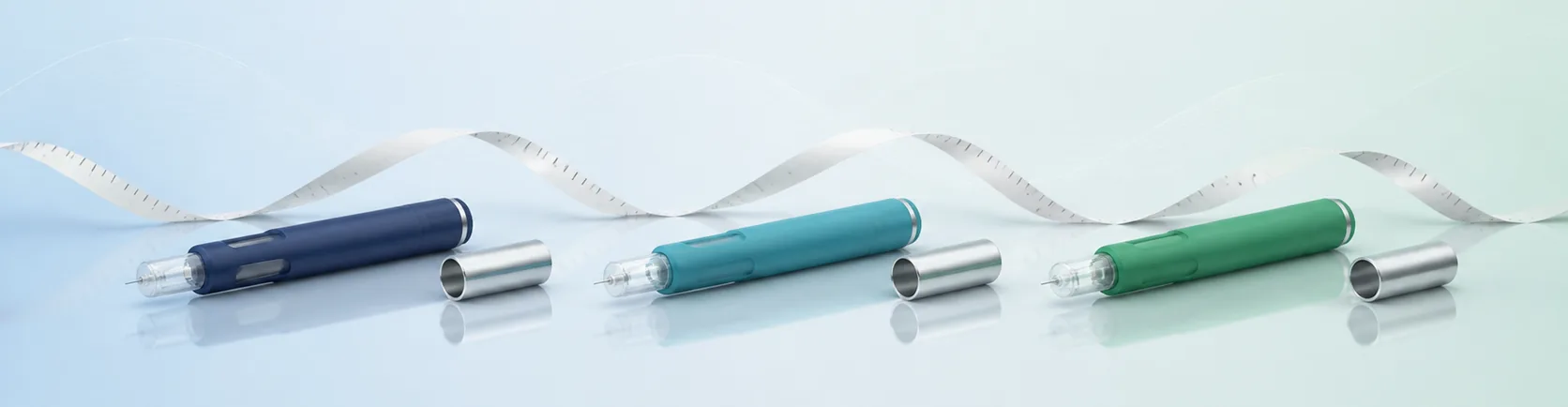
We cover the dosing calendar for each compound, the milligram to unit conversion that vial users have to get right, why escalation is deliberately slow, what a plateau does and does not mean, and the sourcing red flags that turn a dosing question into a safety question. None of this is medical advice or a recommendation to self-administer anything. Prescription injectables require a clinician who has reviewed your history.
What is actually inside a weight loss injection
The injectables people mean by this phrase fall into a small number of pharmacological groups, and the group determines the dosing pattern far more than the brand does.
- GLP-1 receptor agonists. Semaglutide and liraglutide are the approved weight-management members. Semaglutide is weekly, liraglutide is daily. Same receptor, different half-life, completely different calendars.
- Dual GIP and GLP-1 agonists. Tirzepatide is dosed once weekly with 2.5 mg increments.
- Investigational multi-agonists and amylin analogues. Retatrutide and cagrilintide appear constantly in this conversation but have no approved product labelling. Any schedule quoted for them comes from a trial protocol, which is not the same thing as an approved dose.
- Older and non-incretin injectables. A number of compounds marketed for fat loss, including growth-hormone fragments, sit outside the incretin class entirely and have far weaker human evidence. They are dosed on protocols extrapolated from small studies rather than registration trials.
A separate and important distinction: an injection dispensed by a pharmacy against a prescription is a finished drug product with a known concentration. A vial bought as a research chemical is not, and everything downstream of that difference, including whether your dose calculation means anything, depends on it.
The dosing calendar: weekly, daily and everything between
Frequency is set by how long the molecule survives in circulation. Modifications like a fatty-acid chain that binds albumin push half-life from hours to days, which is what converts a daily injection into a weekly one.
| Compound | Frequency | Typical starting dose | Escalation interval | Usual ceiling |
|---|---|---|---|---|
| Semaglutide (weight management label) | Once weekly | 0.25 mg | Every 4 weeks | 2.4 mg weekly |
| Tirzepatide | Once weekly | 2.5 mg | At least 4 weeks between 2.5 mg increments | 15 mg weekly |
| Liraglutide (weight management label) | Once daily | 0.6 mg | Weekly increments of 0.6 mg | 3 mg daily |
| Dulaglutide | Once weekly | 0.75 mg | At least 4 weeks | 4.5 mg weekly |
| Retatrutide (investigational) | Once weekly in trials | Trial protocol dependent | Trial protocol dependent | No approved ceiling |
Two practical consequences follow from the calendar. A weekly injection means a missed dose is a missed week, so the catch-up window in the product instructions matters more than it would for a daily drug. A daily injection means adherence is a daily habit, which suits some people better and others far worse. Neither is inherently superior, and the honest version of the choice includes which one you will still be doing in six months.
Turning milligrams into syringe units
If your injection comes as a prefilled pen, the device handles the measurement and you can skip this section. If it comes as a vial and a syringe, this is where doses go wrong.
A U-100 insulin syringe measures volume, not drug. One unit is 0.01 mL regardless of what is in the barrel. So a dose in milligrams becomes a number of units only once you know the concentration:
- Concentration (mg/mL) = milligrams in the vial divided by millilitres of diluent added.
- Units = (dose in mg divided by concentration in mg/mL) multiplied by 100.
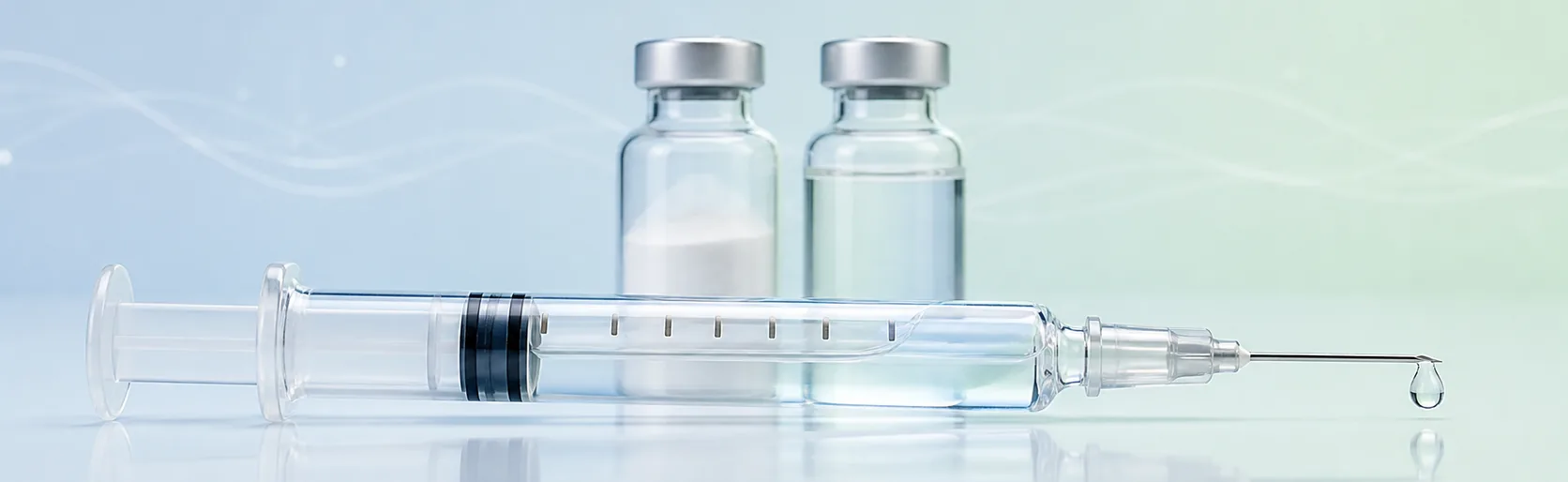
| Vial and diluent | Concentration | Dose | Volume | U-100 units |
|---|---|---|---|---|
| 10 mg in 1 mL | 10 mg/mL | 2.5 mg | 0.25 mL | 25 units |
| 10 mg in 1 mL | 10 mg/mL | 5 mg | 0.5 mL | 50 units |
| 10 mg in 2 mL | 5 mg/mL | 2.5 mg | 0.5 mL | 50 units |
| 5 mg in 2 mL | 2.5 mg/mL | 0.25 mg | 0.1 mL | 10 units |
| 5 mg in 2 mL | 2.5 mg/mL | 1 mg | 0.4 mL | 40 units |
| 5 mg in 2 mL | 2.5 mg/mL | 2.4 mg | 0.96 mL | 96 units |
Read the first three rows again. The dose of 2.5 mg is drawn as 25 units at one dilution and 50 units at another. That is why a unit count copied from a forum, a friend or a video is meaningless without the concentration attached, and why the most dangerous instruction in this entire subject is a bare number of units.
Three habits prevent nearly all of these errors: write the concentration on the vial when it is reconstituted, recalculate rather than reuse a unit count when the vial or dilution changes, and read the syringe from the front face of the plunger stopper. Our reconstitution guide covers the dilution step in detail, the syringe measurement guide covers reading the barrel, and the tirzepatide dose calculator shows the conversion working for a specific vial.
Why the dose climbs slowly instead of starting high
Every approved injectable in this category starts below its effective dose. That is not caution for its own sake. The receptor activity that reduces appetite also slows gastric emptying and triggers nausea, and both effects are dose dependent while tolerance builds over weeks of steady exposure.
Escalating on a fixed interval does three things at once. It lets the gastrointestinal effects settle before the next increment, it allows a weekly drug to reach steady-state concentrations before more is added, and it makes cause and effect legible when a symptom appears. Compressing the ladder tends to produce the same destination with a much higher chance of stopping early.
What the trial evidence supports
In the pivotal weight-management trials, once-weekly semaglutide at 2.4 mg produced roughly 15 percent mean weight reduction over 68 weeks, and tirzepatide produced roughly 15 to 21 percent over 72 weeks across its 5 mg, 10 mg and 15 mg arms [3][4]. Those are group averages from supervised trials with lifestyle support built in. They describe what the dose ladder can achieve, not what any individual will get, and the spread around those means is wide.
The costs are real but not fixed
Nausea, vomiting, diarrhoea and constipation are the dose-limiting effects for most people, and gallbladder events and pancreatitis appear as less common but serious risks in the labelling [1][2]. Reported cost varies enormously by product, indication, insurance status and pharmacy, so treat any single figure you see as a snapshot rather than a rate, and price the maintenance dose rather than the starter dose before committing to a plan.
Dose holds, plateaus and what maintenance means
Two things get misread as failure. The first is a dose hold. Staying at the current dose for an extra cycle because side effects have not settled is a normal, planned part of titration, not a setback. The second is a plateau.
Weight loss on these medicines is not linear. Rate of loss typically slows as body mass falls, because energy requirements fall with it. A plateau at a stable dose usually means the current dose and the current energy balance have found equilibrium, which is information rather than a verdict. The options from there are genuinely clinical: continue at the current dose, escalate if there is room on the ladder and tolerability allows, or address the parts of the picture the injection does not touch, particularly protein intake, resistance training and sleep.
Questions worth taking to a review appointment
- Am I still on the dose I think I am on, measured the way I think I am measuring it?
- Have I held at this dose long enough to judge it, meaning at least a full interval?
- Are side effects limiting the next step, and if so are they manageable or a reason to stop climbing?
- What is the plan for maintenance once the target is reached, including what happens if the medicine stops?
That last question matters more than it usually gets credit for. These medicines treat a chronic condition, and stopping is generally followed by regain unless something else has changed. Planning the maintenance phase belongs in the conversation at the start, not at the end.
Storage, handling and the things that silently change a dose
A correctly calculated dose can still be wrong if the product has degraded or the technique is off.
- Refrigeration. Unopened pens and vials are stored refrigerated at the temperature stated on the carton. Do not freeze them, and do not use a product that has frozen even if it has thawed.
- In-use limits. Products carry an in-use period once opened or reconstituted, after which they are discarded even if solution remains. Reconstituted vials also depend on the diluent used: bacteriostatic water contains a preservative, sterile water does not, which shortens the usable window considerably. Our storage guide covers this in detail.
- Light and agitation. Keep vials in their carton and swirl rather than shake. Aggressive shaking of a peptide solution risks denaturation and foaming, and foam makes an accurate draw harder.
- Air bubbles. A bubble displaces solution, so an apparent 20 units containing a 2 unit bubble is an 18 unit dose. Tap, clear and re-draw.
- Site rotation. Repeated injection into the same spot produces lipohypertrophy, which absorbs unpredictably. Rotating across the abdomen, thigh and upper arm keeps absorption consistent.
Sourcing red flags that turn into dosing errors
The most common cause of a dangerous dose is not bad arithmetic. It is an unknown input. If you do not know the concentration and cannot verify the contents, no calculation downstream is meaningful.
- No prescription required. Injectable incretins require clinical screening. An offer to sell one without a prescription is the clearest signal in this market.
- Research-use-only labelling on something intended for injection. That label means the material was not manufactured, tested or released as a human drug product, and the FDA has warned specifically about unapproved GLP-1 products sold outside the regulated supply chain [5][6].
- No stated concentration, or a concentration you are asked to assume. If the milligram content and diluent are not documented, your unit count is a guess.
- No certificate of analysis for the specific lot. Identity by mass spectrometry and purity by HPLC are the minimum, and a generic certificate that does not match your lot number is not evidence.
- Dosing instructions that quote units without a concentration. As the conversion table shows, that instruction cannot be followed safely by anyone.
- Compounded product without a verifiable pharmacy. If a clinician recommends a compounded preparation, the pharmacy should be identifiable and the concentration and draw volume supplied in writing.
Checklist before the first injection
Work through this once, before the first dose, and again whenever the vial, concentration or product changes.
- Confirm the compound and the indication. Know which molecule, which label and which ceiling applies.
- Write down the concentration. For a vial, calculate it from the milligrams and the diluent volume, and mark it on the vial itself.
- Convert the dose to units and check the arithmetic twice. Units equals dose divided by concentration, multiplied by 100.
- Match the syringe to the volume. A 0.3 mL barrel is far easier to read accurately for small draws than a 1 mL barrel.
- Know the escalation interval before you start. Put the step-up dates in a calendar so the decision is deliberate rather than improvised.
- Know the missed dose rule for your specific product. Read the instructions for use rather than assuming a rule from another brand.
- Confirm storage and in-use dates. Label the vial with the reconstitution date.
- Agree the review point with your clinician. Decide in advance when you will assess response, side effects and whether to climb further.
If you are still comparing compounds rather than doses, the tirzepatide versus semaglutide comparison puts the two schedules side by side, and the beginner's guide covers the underlying pharmacology.
Frequently Asked Questions
How often are weight loss injections given?expand_more
It depends on the molecule's half-life. Semaglutide, tirzepatide and dulaglutide are given once weekly. Liraglutide is given once daily. The frequency is a property of the drug, not a choice, and it is set by how long the compound persists in circulation.
How do I convert a milligram dose into syringe units?expand_more
Divide the dose in milligrams by the concentration in milligrams per millilitre, then multiply by 100, because one unit on a U-100 insulin syringe is 0.01 mL. The same milligram dose is a different number of units at a different concentration, so the unit count is meaningless without the concentration.
Why does the dose start so low?expand_more
The starting dose builds tolerance rather than delivering the full effect. Gastrointestinal side effects are dose related and settle with continued exposure, so stepping up on a fixed interval reaches the same destination with far fewer people stopping in the first month.
What should I do if weight loss stalls?expand_more
A plateau at a stable dose usually reflects a new equilibrium rather than a failure. The options are to hold, to escalate if the ladder and tolerability allow, or to address what the injection does not cover, including protein intake, resistance training and sleep. It is a review conversation with a prescriber, not a reason to self-escalate.
Can I inject a weight loss medication bought without a prescription?expand_more
No. Material sold without a prescription is not a released human drug product, its concentration and identity are unverified, and the FDA has warned specifically about unapproved GLP-1 products sold outside the regulated supply chain. Without a verified concentration, no dose calculation is meaningful.
Do I have to reach the maximum dose?expand_more
No. Several products explicitly allow maintenance at a lower dose when the higher one is not tolerated, and there is no requirement to climb further once the clinical target is being met. The dose response flattens near the top of the ladder.
References & Citations
- [1]
FDA prescribing information, Wegovy (semaglutide) injection, including dosage, administration and warnings.View source →
- [2]
FDA prescribing information, Mounjaro (tirzepatide) injection, including titration schedule and storage.View source →
- [3]
Wilding JPH, Batterham RL, Calanna S, et al. (2021) N Engl J Med. Once-Weekly Semaglutide in Adults with Overweight or Obesity (STEP 1).View source →
- [4]
Jastreboff AM, Aronne LJ, Ahmad NN, et al. (2022) N Engl J Med. Tirzepatide Once Weekly for the Treatment of Obesity (SURMOUNT-1).View source →
- [5]
FDA. Medications containing semaglutide marketed for type 2 diabetes or weight loss.View source →
- [6]
NIDDK. Prescription Medications to Treat Overweight and Obesity.View source →