Retatrutide Half-Life: About 6 Days, and the Maths Behind It
Retatrutide's half-life is about 6 days. How long it stays in your system, what steady state looks like, and why vial storage is a separate clock.
MEDICAL DISCLAIMER: Educational research guidelines only. Lyophilized peptides are investigational chemical compounds and are NOT approved for human consumption, diagnosis, or therapy. Consult a licensed physician before any research application.
The retatrutide half-life is approximately 6 days. That figure comes from the phase 1b multiple-ascending-dose trial in people with type 2 diabetes (Urva et al., The Lancet, 2022), which reported that the pharmacokinetics were dose proportional and the half-life was approximately 6 days. It is the reason retatrutide is studied as a once-weekly injection, and it also answers the follow-up question people search: how long it stays in your system. By simple arithmetic, a little over a month.
This page works that number through as arithmetic: how much of a dose is left after each week, what a stack of weekly doses builds up to, how it compares with tirzepatide and semaglutide, and why the shelf life of a reconstituted vial is a different clock entirely. Retatrutide is still an investigational drug and not approved anywhere, so everything here is pharmacology and bench maths, not dosing advice.
What the published data says about retatrutide's half-life
A half-life is the time it takes for the concentration of a drug in the blood to fall by half once absorption is finished. Two primary sources matter for retatrutide, which Lilly's trials code-name LY3437943:
- Urva et al., The Lancet, 2022 (phase 1b, NCT04143802). 72 adults with type 2 diabetes received once-weekly injections for 12 weeks. The paper states that pharmacokinetics were dose proportional and the half-life was approximately 6 days, and concludes that the profile suggests suitability for once-weekly dosing.
- Coskun et al., Cell Metabolism, 2022 (first-in-human). After a single dose, the abstract reports that the pharmacokinetic profile supported once-weekly dosing and that a reduction in body weight persisted up to day 43. That is an effect duration, not a half-life, and it should not be read as one.
Two cautions apply. First, "approximately 6 days" is a population average, and individual half-lives vary around it. Second, no regulator has published a prescribing label for retatrutide, so there is no label table of exposure by dose, no renal or hepatic adjustment and no stated time to steady state. Where this page gives such numbers, they are derived from the 6-day figure and are labelled as arithmetic.
Retatrutide half-life compared with other weekly injectables
Six days sits in the middle of the weekly incretin class. The comparison figures below come from the current FDA labels for each approved drug.
| Compound | Half-life | Source | Dosing interval |
|---|---|---|---|
| Tirzepatide (Mounjaro, Zepbound) | About 5 days (Zepbound label: 5 to 6 days in obesity) | FDA labels | Weekly |
| Dulaglutide (Trulicity) | About 5 days | FDA label | Weekly |
| Retatrutide (investigational) | About 6 days | Urva et al., Lancet 2022 | Weekly in trials |
| Semaglutide (Ozempic) | About 1 week | FDA label | Weekly |
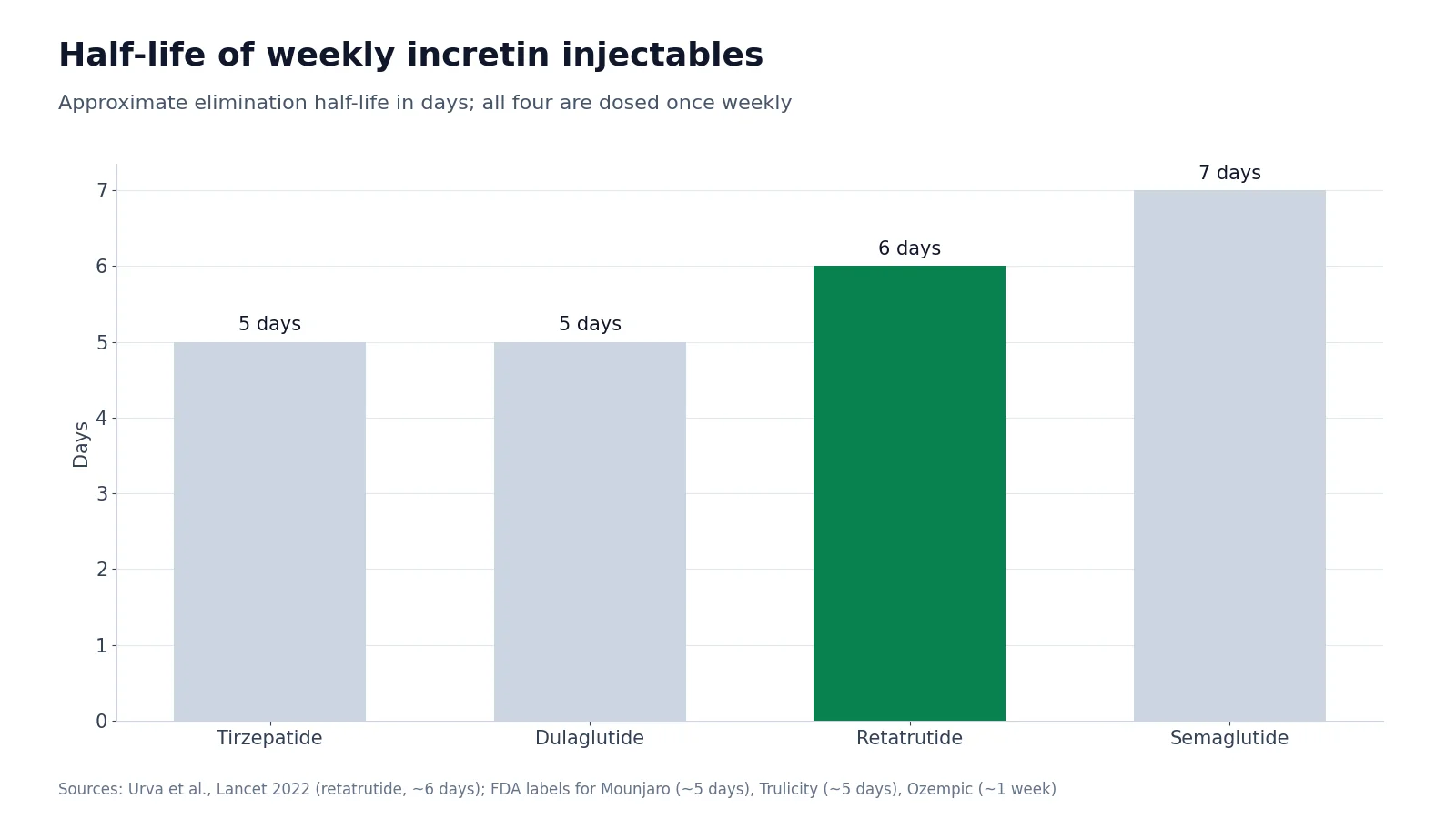
The practical point is that all four are built to be dosed about once per half-life. That is why a weekly schedule keeps the level steady without large daily swings. For the nearest approved comparator, see the tirzepatide dosage page; how the drugs differ in mechanism is a separate question from clearance.
How long retatrutide stays in your system
If elimination is first-order, which is the standard simplification, the amount remaining after t days is 0.5 raised to the power of (t divided by 6). For each 1 mg of drug in circulation at the moment of the last dose:
| Days after last dose | Half-lives elapsed | Fraction remaining | Left of each 1 mg |
|---|---|---|---|
| 6 | 1 | 50% | 0.500 mg |
| 12 | 2 | 25% | 0.250 mg |
| 18 | 3 | 12.5% | 0.125 mg |
| 24 | 4 | 6.3% | 0.063 mg |
| 30 | 5 | 3.1% | 0.031 mg |
| 42 | 7 | 0.8% | 0.008 mg |
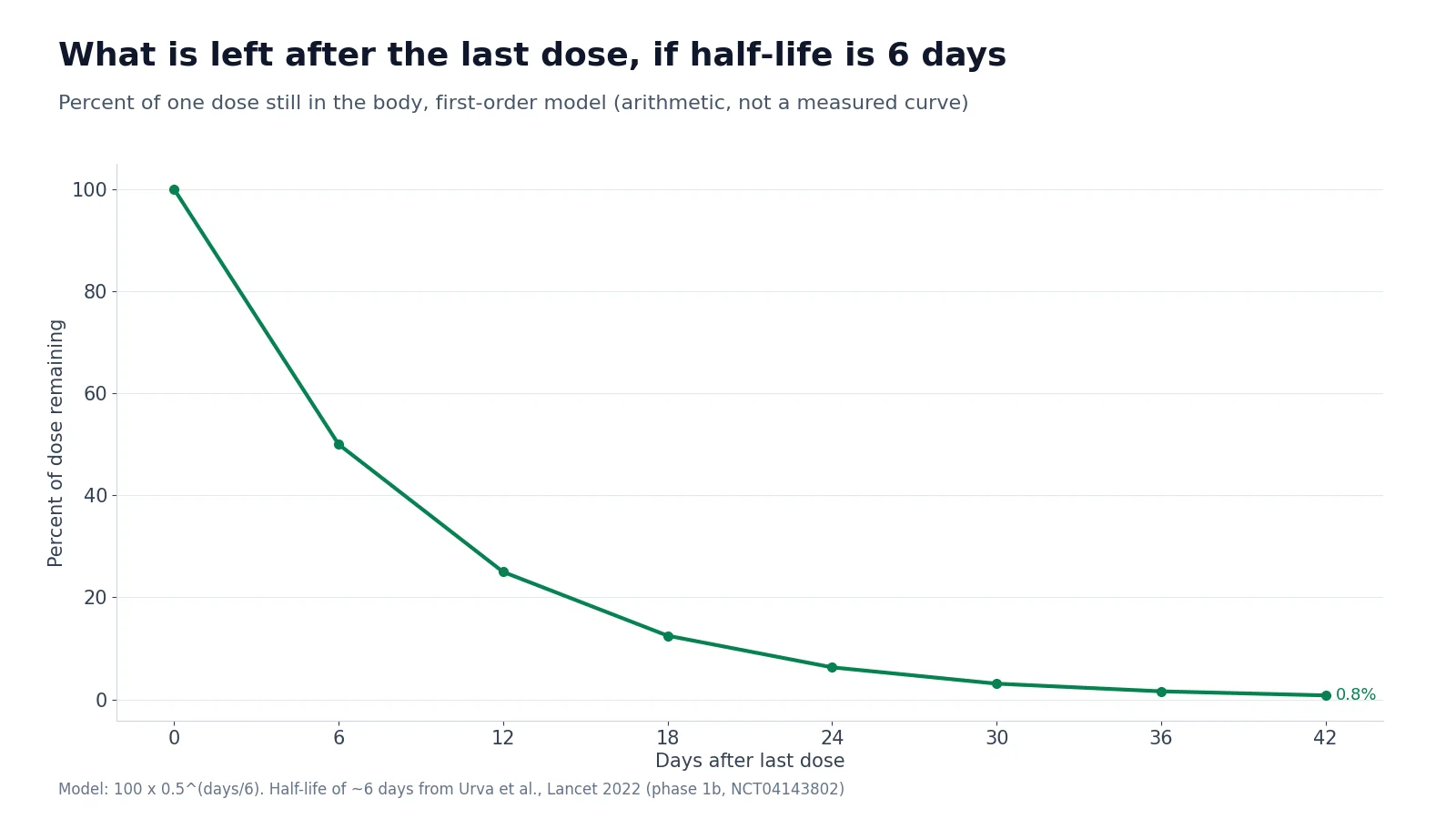
The usual rule of thumb is that a drug is effectively cleared after about five half-lives. For a 6-day half-life that is 30 days, with roughly 3% left. For comparison, the Ozempic label applies the same reasoning to semaglutide: with a half-life of about one week, it states the drug will be present in the circulation for about 5 weeks after the last dose.
No retatrutide-specific washout study has been published, so 30 days is a calculation rather than a measurement. It also says nothing about when effects fade: the first-in-human paper found a single dose reduced body weight for up to 43 days, and biological effects do not track blood concentration one for one.
Steady state: what repeated weekly doses build up to
With a 6-day half-life and a 7-day interval, a week of decay leaves 0.5^(7/6) = 0.4455 of the previous level. Call that fraction f. Each new dose lands on top of what is left, so the pre-dose level climbs toward a ceiling of f divided by (1 minus f), about 0.80, measured in units of one dose. The same series gives an accumulation factor of 1 divided by (1 minus f), about 1.80, which is how much higher the average level sits than after a single isolated dose.
| Weekly dose number | Amount left just before the next dose | Share of the steady-state ceiling |
|---|---|---|
| 1 | 0.45 of one dose | 55% |
| 2 | 0.64 of one dose | 80% |
| 3 | 0.73 of one dose | 91% |
| 4 | 0.77 of one dose | 96% |
| 5 | 0.79 of one dose | 98% |
So by the fourth or fifth weekly dose the level has reached about 96 to 98% of its plateau, which is roughly 4 to 5 half-lives, about 24 to 30 days. This is a single-compartment simplification that ignores the absorption phase, and it holds only if the same amount is given each week. In the trials, doses were stepped up gradually, so the actual curve keeps rising as each step is added.
This accumulation is the pharmacological reason escalation schedules exist and why a mistake is slow to undo: whatever is in the body at week 5 is mostly the sum of earlier weeks. The status of those trial doses is covered on the retatrutide side effects page, and the trial-schedule framing is on the retatrutide protocol page.
Retatrutide storage: a different clock from half-life
Half-life describes how fast the molecule leaves a body. It says nothing about how long a vial stays usable on a shelf or in a fridge. Mixing the two up leads to a common error, which is assuming a vial that is "good for six days" or "cleared in 30 days" because of the pharmacology.
The two clocks are independent:
- Biological clock. About 6 days per halving once it is in the body.
- Vial clock. Stability of the powder, then of the solution after reconstitution, governed by temperature, light and how the vial is handled.
Because retatrutide is not approved, there is no manufacturer storage instruction or beyond-use date from a regulator, and a seller's printed storage claim is just that, a claim. General handling principles for lyophilised peptides and reconstituted solutions are laid out in the peptide storage guide, and the dilution step itself in the reconstitution guide.
The arithmetic that does carry over is concentration. A 10 mg vial reconstituted in 2 mL is 5 mg/mL, so each 10 units (0.1 mL) on a U-100 syringe holds 0.5 mg. Adding water changes the volume per unit, not the amount in the vial or the half-life. The syringe measurement guide covers reading the barrel.
Where retatrutide stands in November 2026
As of 5 November 2026, retatrutide is an investigational drug. It is not approved by the FDA or, to the best of the public record, any other regulator, and Lilly's press releases still call it "investigational" and use no brand name for it. The phase 3 programme is reporting:
- TRIUMPH-1 (obesity, announced 21 May 2026): at 80 weeks, average weight loss was 19.0% (4 mg), 25.9% (9 mg) and 28.3% (12 mg) versus 2.2% on placebo, on the efficacy estimand.
- TRIUMPH-2 (type 2 diabetes and obesity, 29 September 2026, with a Lancet publication): average weight loss of 12.7%, 19.1% and 20.8% at 4, 9 and 12 mg at 80 weeks.
- TRANSCEND-T2D-2 (28 October 2026): retatrutide beat Ozempic 2 mg on A1C and weight at 80 weeks in a head-to-head trial.
In the TRIUMPH-2 release Lilly said it plans to submit a Biologics License Application to the FDA in the first quarter of 2027. A submission is not an approval, and an approved label, when it exists, will be the authoritative place for half-life, steady-state and storage statements.
Product sold online as retatrutide is not that drug supplied by Lilly, and its milligram content is unverified unless independent testing shows otherwise, which matters for every calculation above because the arithmetic assumes the label amount is true. For anyone weighing a seller, Middleway Nutrition publishes a guide on how to check a retatrutide supplier, and this site's own cost-per-mg arithmetic is on the where to buy retatrutide page.
Frequently Asked Questions
What is the half-life of retatrutide?expand_more
About 6 days. The phase 1b trial in people with type 2 diabetes (Urva et al., The Lancet, 2022) reported dose-proportional pharmacokinetics and a half-life of approximately 6 days, which supports once-weekly administration.
How long does retatrutide stay in your system?expand_more
By first-order arithmetic, about 5 half-lives, or roughly 30 days, to fall to about 3% of the last dose. No retatrutide-specific washout study has been published, so this is a calculation, and effects on weight can outlast blood levels: a first-in-human single dose lowered body weight for up to 43 days.
Why is retatrutide dosed once a week?expand_more
Because a half-life near 6 days means about 45% of a dose is still present after 7 days, so weekly injections keep exposure fairly steady. Once-weekly dosing was the schedule used in the phase 1, 2 and 3 trials.
How long until retatrutide reaches steady state?expand_more
On the 6-day half-life, repeated weekly doses reach about 96 to 98% of the plateau by the fourth or fifth dose, roughly 24 to 30 days. This is a simplified single-compartment estimate and not a figure from a published label.
How should retatrutide be stored?expand_more
There is no manufacturer storage instruction because the drug is not approved. Half-life does not determine vial stability. For general handling principles for lyophilised and reconstituted peptides, see the peptide storage guide on this site.
Is retatrutide FDA approved?expand_more
No. As of 5 November 2026 it is investigational. Lilly has reported positive phase 3 results and said it plans to submit a Biologics License Application to the FDA in the first quarter of 2027.
References & Citations
- [1]
Urva S, et al. LY3437943, a novel triple GIP, GLP-1, and glucagon receptor agonist in people with type 2 diabetes: a phase 1b, multicentre, double-blind, placebo-controlled, randomised, multiple-ascending dose trial. Lancet. 2022;400:1869-1881. NCT04143802.View source →
- [2]
Coskun T, et al. LY3437943, a novel triple glucagon, GIP, and GLP-1 receptor agonist for glycemic control and weight loss: from discovery to clinical proof of concept. Cell Metab. 2022;34:1234-1247.View source →
- [3]
Jastreboff AM, et al. Triple-hormone-receptor agonist retatrutide for obesity, a phase 2 trial. N Engl J Med. 2023;389:514-526. NCT04881760.View source →
- [4]
Eli Lilly and Company. Lilly's triple agonist, retatrutide, delivered powerful weight loss in pivotal Phase 3 obesity trial (TRIUMPH-1). Press release, 21 May 2026.View source →
- [5]
Eli Lilly and Company. Lilly's triple agonist, retatrutide, delivered substantial weight loss and A1C reduction (TRIUMPH-2, EASD and The Lancet). Press release, 29 September 2026. States the planned Q1 2027 BLA submission.View source →
- [6]
Eli Lilly and Company. Lilly's retatrutide delivered greater A1C reduction and more than double the weight loss of Ozempic's highest approved dose in head-to-head trial (TRANSCEND-T2D-2). Press release, 28 October 2026.View source →
- [7]
US prescribing information, half-life statements: Mounjaro and Zepbound (tirzepatide), Trulicity (dulaglutide), Ozempic (semaglutide). FDA labels via openFDA.View source →