mg to mL Converter
To convert mg to mL, divide the milligrams by the concentration in mg/mL — 1 mg at 5 mg/mL is 0.2 mL, which is 20 units on a U-100 insulin syringe. Milligrams are mass and millilitres are volume, so the concentration is the only bridge between them. Use the tools below to go from a dose to mL and syringe units, convert mg and mL in either direction, check what dose is in a number of units, or convert g, mg and mcg.
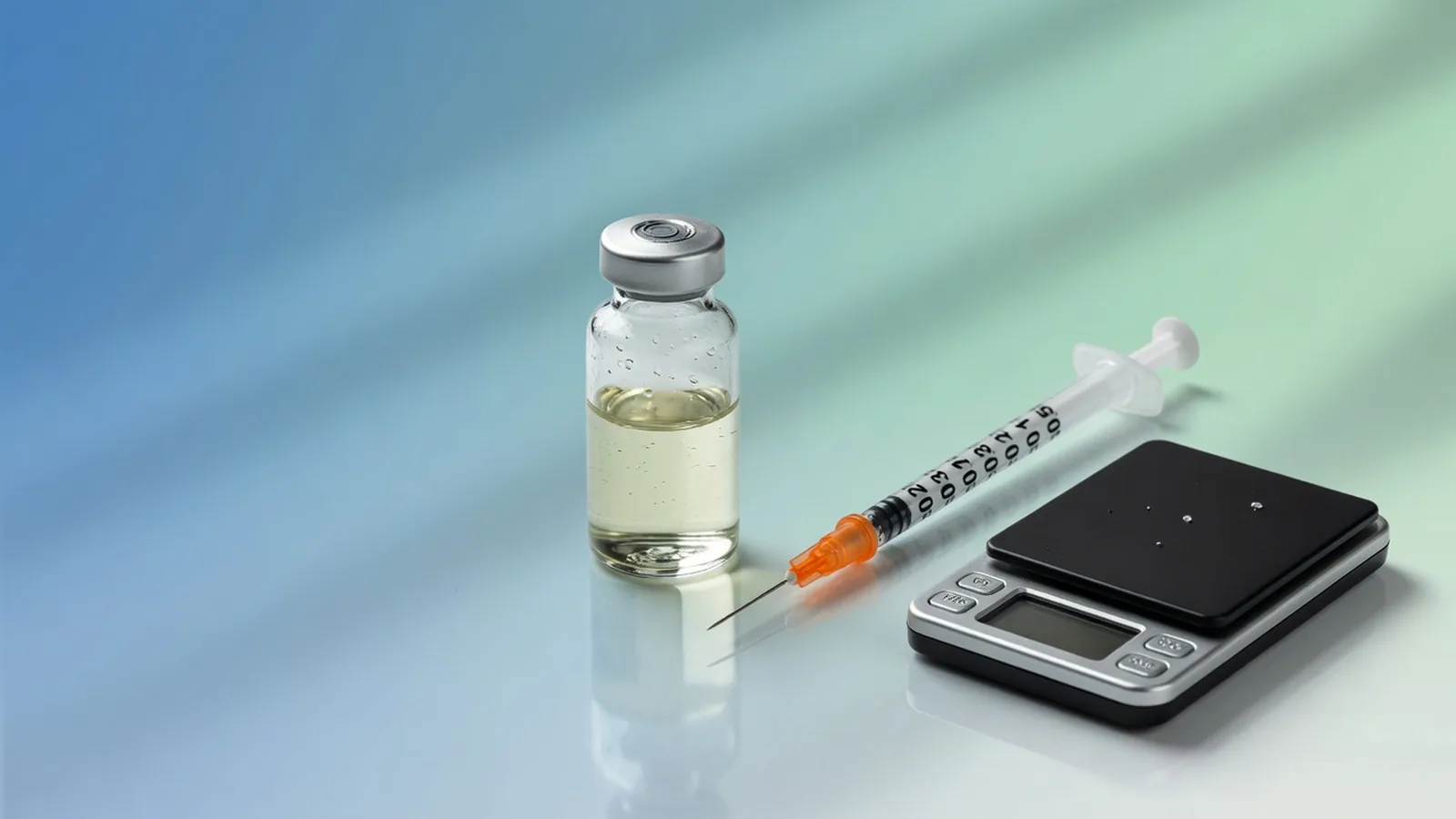
MEDICAL DISCLAIMER: Educational research guidelines only. Lyophilized peptides are investigational chemical compounds and are NOT approved for human consumption, diagnosis, or therapy. Consult a licensed physician before any research application.
Dose → mL and syringe units
Vial strength and the water you add set the concentration; the dose then fixes the volume and the U-100 units.
mg ↔ mL at a known concentration
Enter the concentration printed on the label or worked out from your vial, then convert either way.
mL = mg ÷ concentration · mg = mL × concentration. On a U-100 syringe, 0.2 mL is 20 units.
Syringe units → mg
Reverse check: what dose is in the units you drew at this concentration.
g ↔ mg ↔ mcg
Plain mass conversion — no concentration needed. 1 g = 1,000 mg = 1,000,000 mcg.
The three formulas
- Concentration (mg/mL) = vial contents (mg) ÷ water added (mL)
- Volume (mL) = dose (mg) ÷ concentration (mg/mL)
- U-100 units = volume (mL) × 100
Doses written in micrograms convert first: 1 mg = 1,000 mcg, so 250 mcg is 0.25 mg. Most mistakes on this maths are a unit slip (mcg read as mg is a 1,000-fold error) or forgetting that more water means a weaker concentration and more units for the same dose. For reading the syringe itself, see the insulin syringe guide; for mixing a vial, the reconstitution guide.
Worked examples
Example vials only — use the numbers on your own vial.
| Vial | Water | Concentration | Dose | Volume | U-100 units |
|---|---|---|---|---|---|
| 5 mg | 2 mL | 2.5 mg/mL | 0.25 mg (250 mcg) | 0.1 mL | 10 units |
| 5 mg | 2 mL | 2.5 mg/mL | 1 mg (1000 mcg) | 0.4 mL | 40 units |
| 10 mg | 2 mL | 5 mg/mL | 0.25 mg (250 mcg) | 0.05 mL | 5 units |
| 10 mg | 2 mL | 5 mg/mL | 2.5 mg (2500 mcg) | 0.5 mL | 50 units |
| 10 mg | 1 mL | 10 mg/mL | 0.5 mg (500 mcg) | 0.05 mL | 5 units |
| 2 mg | 1 mL | 2 mg/mL | 0.1 mg (100 mcg) | 0.05 mL | 5 units |
Compound-specific calculators
Every compound on this site has its own calculator preloaded with a common vial size, for example semaglutide, tirzepatide, retatrutide, BPC-157 and TB-500. The peptide calculator guide explains which tool fits which job.
Frequently Asked Questions
How do you convert mg to mL?expand_more
Divide the milligrams by the concentration in mg/mL. At 5 mg/mL, 1 mg is 1 ÷ 5 = 0.2 mL. Milligrams measure mass and millilitres measure volume, so there is no fixed conversion between them without a concentration.
Is 1 mg the same as 1 mL?expand_more
Only for a solution whose concentration is exactly 1 mg/mL. For pure water, 1 mL weighs about 1 g (1,000 mg), not 1 mg. For any medicine or reconstituted peptide, use the concentration on the label or the one you worked out from the vial.
How many units are in 1 mL on an insulin syringe?expand_more
A U-100 insulin syringe holds 100 units per mL, so 1 unit is 0.01 mL. A 0.5 mL syringe holds 50 units and a 0.3 mL syringe holds 30 units.
How do I convert mg to units on an insulin syringe?expand_more
First convert mg to mL with the concentration (mL = mg ÷ mg/mL), then multiply by 100 for a U-100 syringe. At 5 mg/mL, a 0.25 mg dose is 0.05 mL, which is 5 units.
What does the bacteriostatic water amount change?expand_more
Only the concentration, not the total dose in the vial. More water makes each unit weaker, so you draw more units for the same dose; less water makes each unit stronger. Pick a volume that lands your dose on readable syringe marks.
Can I use this for prescription pens like Ozempic or Mounjaro?expand_more
Pens deliver labelled doses by dial or fixed dose, not by syringe units, so you do not convert them. The units maths applies to vials you draw with a syringe. Follow your prescriber and the product's instructions for use.