Peptides for Dogs: Why This Dosing Site Will Not Give You a Dose
Peptides for dogs: a dosing site explains why it publishes no canine figure, which peptide medicines are actually approved, and where the lawful route runs.
MEDICAL DISCLAIMER: Educational research guidelines only. Lyophilized peptides are investigational chemical compounds and are NOT approved for human consumption, diagnosis, or therapy. Consult a licensed physician before any research application.
Peptides for dogs is a search that arrives here expecting arithmetic. This site does arithmetic for a living: vial concentrations, syringe graduations, the gap between what a label claims and what a certificate measures. This is the page where the arithmetic stops, and the reason it stops is the article.
You will not find a figure below. No milligram amount, no weight-scaled calculation, no frequency, no worked example carrying a warning. That is neither squeamishness nor a legal reflex. No honest source can hand a pet owner a dose for an animal that cannot consent, cannot refuse, and cannot say afterwards that something feels wrong.
There is a version of this page that says peptides are not approved for dogs, ask your vet, and stops. That version is wrong. Peptide medicines for dogs exist, several are FDA approved, and dogs receive them daily on veterinary instruction. Insulin is a peptide. What has no dose to give is the research-peptide market, and everything useful below lives in the distance between those two facts.
Peptides for dogs: the number this page is not going to give you
Here is the refusal first, rather than buried under context you would have to read past. There is no dose on this page for any research peptide in a dog, and none further down where the real answer might be expected to hide. Four things are true at once, and any one of them would be enough.
- Nobody has established one. A dose that means anything is the output of a development programme: pharmacokinetics in the target species, dose-ranging work, a safety margin, labelling that survived review. None of that exists to be quoted, and a number published without it is a guess in the typography of a fact.
- The patient cannot participate. Every dose an adult takes runs alongside a commentary only they can hear: nausea, light-headedness, the sense that this was a mistake. A dog contributes none of it, and its instinct under discomfort is often to hide rather than signal.
- The margin is narrower and the monitoring absent. A companion animal is a fraction of an adult human by mass, and a kitchen has no bloodwork, no observation chart and nobody trained to recognise an adverse reaction in its first hour.
- A number here becomes a number used tonight. Traffic on this phrase is not academic. Somebody has a vial on the counter already, and no disclaimer stapled underneath has ever outrun a printed figure.
Where our other pages carry figures, each traces back to a label, a published trial or a batch certificate, as our guide to where reliable peptide dosing references come from sets out. For research peptides in dogs, nothing sits at the end of that chain. Inventing a number to satisfy a query would be the failure of a dosing site, not the refusal to.
Some peptide medicines for dogs are approved, and none arrive in a research vial
Peptides are neither exotic in veterinary medicine nor banned from it. A peptide is a short chain of amino acids, which our beginner's guide to what peptides are covers in more detail, and that definition takes in a good deal of ordinary medicine. Insulin is a peptide hormone. Vetsulin, a porcine insulin zinc suspension, is described by its manufacturer Merck Animal Health as the first FDA-approved insulin for use in dogs and cats with diabetes, at a dose a veterinarian sets and then adjusts against measured blood glucose in that individual animal.
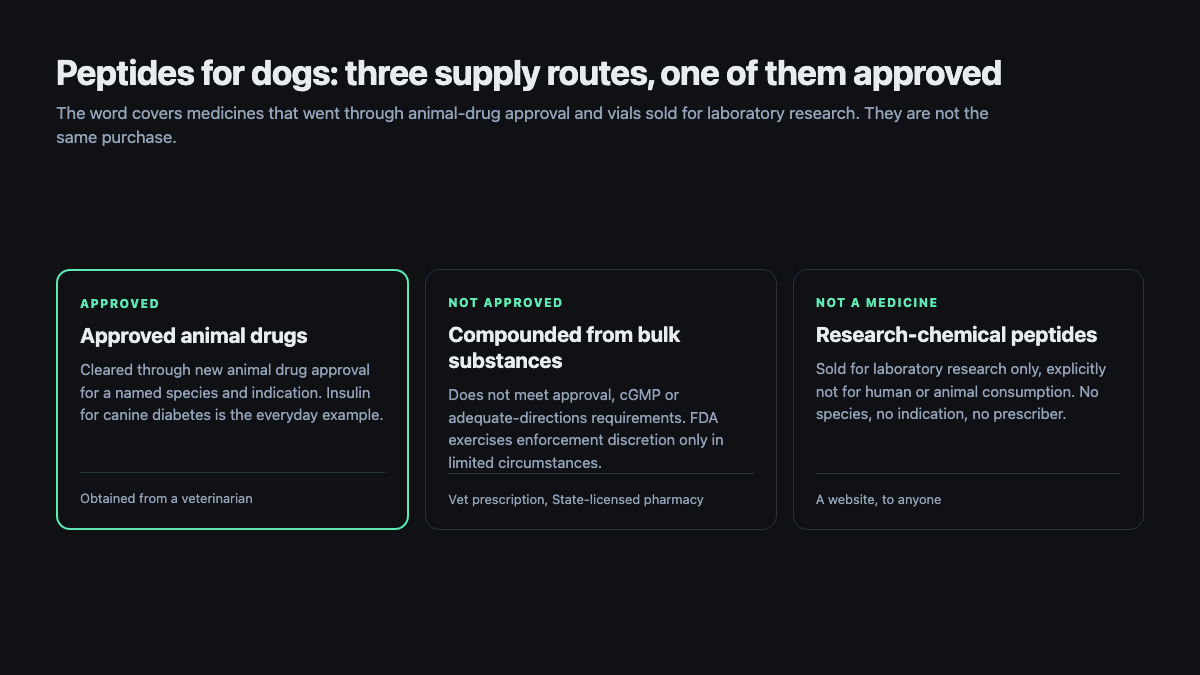
So the honest sentence is that some peptide medicines are approved for dogs and none of the compounds sold on research-peptide websites are among them. One word covers three transactions sharing nothing but a chemistry term.
| Lane | What it is | Where it comes from |
|---|---|---|
| Approved animal drugs | Cleared through new animal drug approval for a named species and indication. Insulin for canine diabetes is the everyday example. | A veterinarian, and a pharmacy |
| Compounded from bulk substances | Not approved. FDA exercises enforcement discretion in limited circumstances, described below. | A veterinary prescription, filled by a State-licensed pharmacy |
| Research-chemical peptides | Sold for laboratory research only, explicitly not for human or animal consumption. No species, no indication, no prescriber. | A website, to anyone with a card |
What changes across those rows is not potency and not purity, both of which can be respectable in the third row. It is whether anyone ever asked and answered the question this page is about: how much, in this species, for this problem, with what expected to happen next.
What FDA actually permits, and the gap a research vial falls into
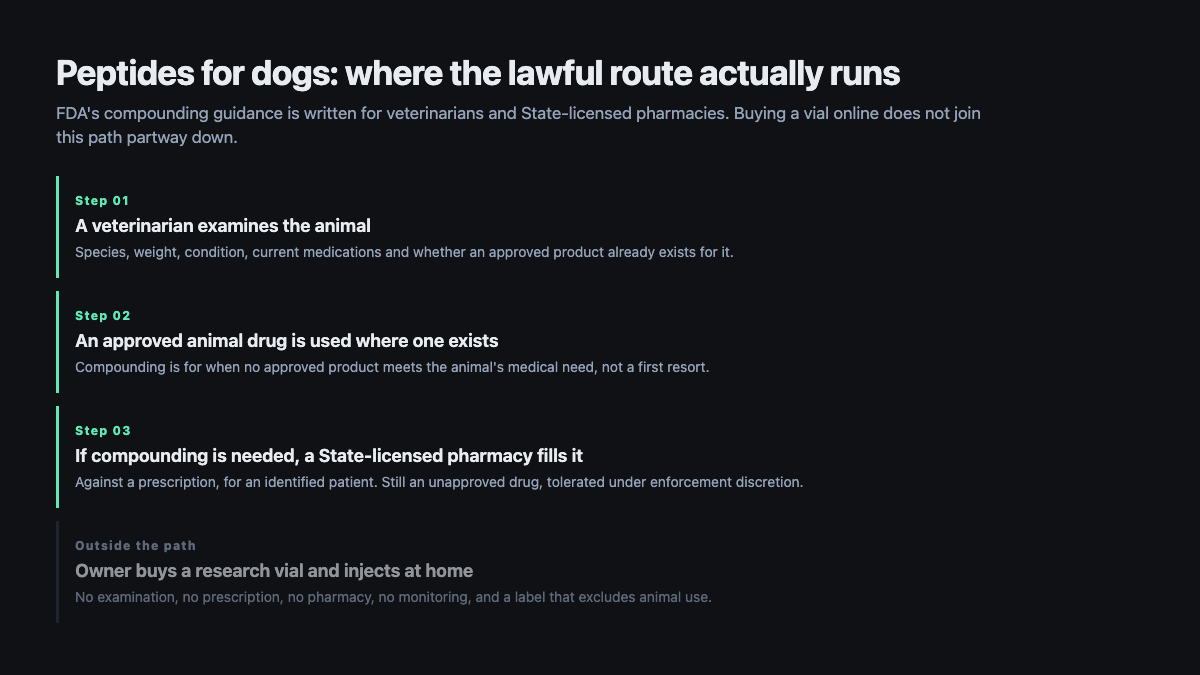
The middle lane answers the obvious objection, that surely a vet can simply have it made up. Sometimes, yes. FDA's Center for Veterinary Medicine set out its position in guidance for industry number 256, Compounding Animal Drugs from Bulk Drug Substances, docket FDA-2018-D-4533, finalised in August 2022.
Animal drugs that are compounded from bulk drug substances do not meet the FD&C Act's new animal drug approval, cGMP, or adequate directions for use requirements. However, FDA has generally exercised enforcement discretion with regard to animal drug compounding from bulk drug substances under certain circumstances.
Two features matter more to an owner than the paragraph itself. The first is the stated audience: veterinarians, State-licensed pharmacies and Federal facilities, compounding for nonfood-producing animals under limited circumstances when no other medically appropriate treatment options exist. Somebody buying a vial from a research-peptide site is not further back along that pathway. They are not on it. The second is that enforcement discretion is not approval. It describes what the agency does not currently intend to pursue, on its current understanding of the risks, and can be revisited.
The other route people reach for is off-label use, and it is real. The Animal Medicinal Drug Use Clarification Act of 1994 permits veterinarians to prescribe extralabel uses of certain approved new animal drugs and approved human drugs for animals under certain conditions, within a valid veterinarian-client-patient relationship. Vets rely on it constantly.
Read that carefully, because for a dosing site it is the crux of the page. The regulations define extralabel use as a departure from approved labelling, including use in species not listed, for indications not listed, or at dosage levels, frequencies or routes other than those stated. Every departure is measured from something. Off-label dosing is a clinician moving deliberately away from an established number with the original in view. A research peptide has no approved labelling anywhere, so there is no figure to depart from, and no way to prescribe it off-label: the statute reaches approved drugs used unapprovedly, not unapproved substances.
Why a canine dose cannot be reverse engineered from a human one
The reasoning behind this question is rarely stated out loud: a dog is a smaller mammal, a human amount is widely repeated, so the dog's amount is presumably that one shrunk in proportion. It feels like arithmetic. It is not, and the reasons are structural rather than cautious.
Species are not scaled copies of one another. Absorption, distribution, metabolism and elimination differ between humans and dogs in ways that get measured rather than deduced. Enzyme activity, transporter expression and plasma protein binding all differ, and for peptides so do the enzymes that cut them apart. Allometric scaling exists as a discipline, and what it yields is a starting hypothesis for designing an animal study: the input to an investigation, not a replacement for one.
The species holds more variation than most labels do. A toy breed and a giant breed are the same species and barely the same animal by mass, and they differ in metabolic rate, body composition and breed-associated sensitivities to particular drug classes. An approved veterinary product handles that with data. Nothing else can.
The number would need a purpose before it needed a size. Dose is inseparable from indication, and there is no approved indication for any research peptide in dogs. A hypothetically perfect figure would still be an amount of something, given for nothing in particular, with no endpoint to say whether it worked or when to stop. That is not a dose. It is a quantity.
What the evidence base for peptides for dogs contains, and what it does not
The gap between studied and shown to work in your dog is where most of the marketing in this category lives, so it is worth naming what sits on the shelf. Something genuinely does sit there. It is not the thing the sales copy implies.
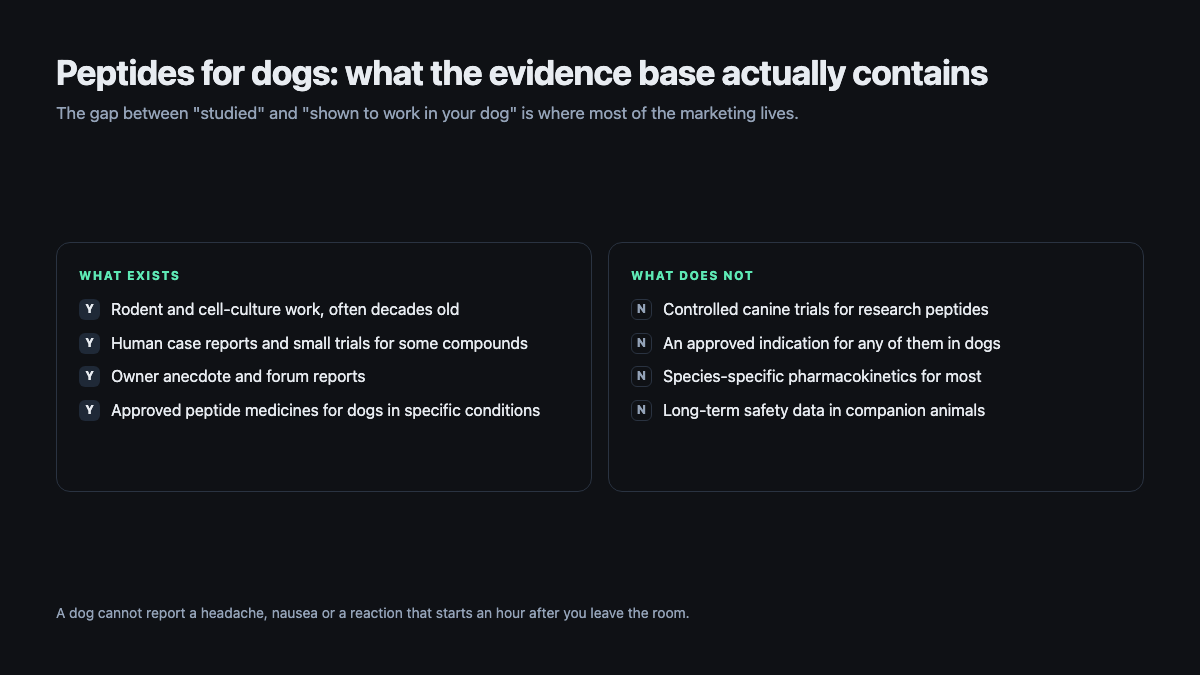
BPC-157 is the compound most often discussed for dogs, usually for joints, gut problems or soft-tissue recovery, and it is a fair example of the shape of this literature. The supporting work is overwhelmingly rodent and in vitro, much of it decades old, alongside owner anecdote and vendor testimonial, and BPC-157 has never been approved for any indication in any market. What is absent is not a detail: controlled canine trials, species-specific pharmacokinetics, an approved indication, long-term safety data in companion animals.
None of that makes the compounds inert, and this page does not claim they do nothing. The point is narrower and harder to argue with: an evidence base of that composition cannot produce a dose, because a dose is downstream of exactly the studies that are missing. Anyone quoting a canine figure is quoting a source that was never done.
For the fuller compound-by-compound treatment, including the dosing-by-weight material we have deliberately declined to reproduce here, Peptide Deck's guide to peptides for dogs, covering BPC-157 and dosing by weight goes considerably deeper than this page does. Linking to a fuller resource and copying its numbers into a page that just argued against them are different acts.
Sterility and endotoxin matter more here, not less
There is a reflex in this market to treat a certificate of analysis as the end of the safety conversation. It is a reasonable document to want, so be exact about what one covers.
A certificate describes a sampled aliquot from a batch on a date. Purity by HPLC says how much of the material is the intended sequence, identity by mass spectrometry stops that figure describing the wrong molecule confidently, an endotoxin screen says the sample sat under a limit, and a sterility screen says nothing grew from what was tested. The compendial reference for bacterial endotoxins testing is USP Chapter 85. All of it is information about a laboratory, before filling, before transit, and before a vial was opened in a house.
What no certificate speaks to is what happens after the seal is broken. Sterility is a property of a moment, kept or lost by handling, diluent, storage and how long a reconstituted vial sits, which our peptide storage and stability guide covers for laboratory work. The animal-specific problem sits on top: a smaller body, no bloodwork, and a patient that cannot report early fever, injection-site pain or the start of a systemic reaction. The margin for a contamination event is thinner and the detection slower, and a clean document compensates for neither.
Where this ends: a veterinarian, and the questions worth arriving with
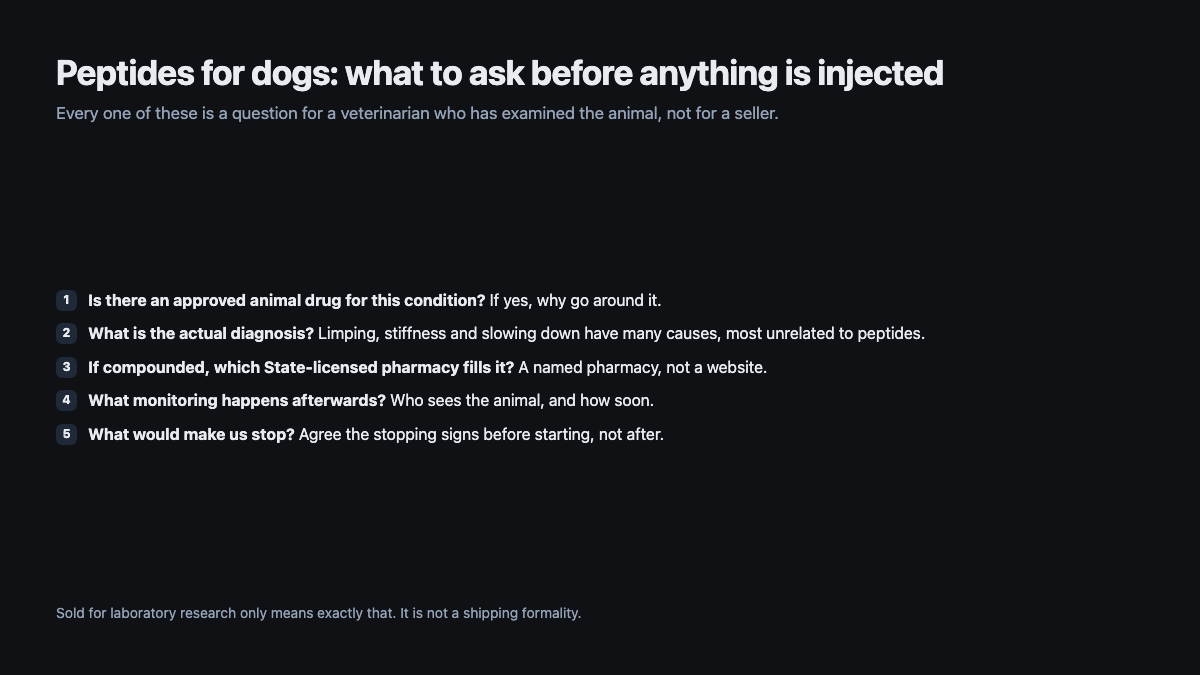
Every route in this article terminates in the same place, which is the conclusion of the argument rather than a retreat from it. A veterinarian is the only participant who can examine the animal, reach a diagnosis, check whether an approved product already exists, arrange a lawful supply if anything unapproved is justified, and monitor what follows. Any dose is theirs to set for that animal, and it cannot be pre-computed by a website that has never met the dog. Arriving with a specific list changes that appointment.
- Is there an approved animal drug for this condition? If there is, the obvious question is why go around it.
- What is the actual diagnosis? Limping, stiffness and slowing down have many causes, most unrelated to peptides and several of them treatable.
- If something is compounded, which State-licensed pharmacy fills it? A named pharmacy, on a prescription, for an identified patient. Not a website.
- What monitoring happens afterwards? Who sees the animal again, how soon, and what gets measured.
- What would make us stop? Agree the stopping signs before anything starts, not after something has gone wrong.
Nothing here is veterinary advice or a recommendation for or against any compound. It is an explanation of why the figure you came for does not exist, written by people whose ordinary job is publishing figures. That we could not find one to publish is the finding, not the omission.
Frequently Asked Questions
What is the correct dose of peptides for dogs?expand_more
There is no established dose for research peptides in dogs, and this page does not publish one. A meaningful dose comes from species-specific pharmacokinetics, dose-ranging studies and approved labelling, none of which exist for these compounds in dogs. Approved peptide medicines for dogs, insulin for canine diabetes among them, do have real dosing that a veterinarian sets for the individual animal.
Can I scale a human peptide dose down to my dog by bodyweight?expand_more
No, and the reason is structural rather than cautious. Absorption, distribution, metabolism and elimination differ between species in ways that have to be measured, including the enzymes that break peptides down. Allometric scaling produces a hypothesis for designing an animal study, not a usable amount, and dogs themselves vary enormously in mass and breed-associated drug sensitivities.
Can a veterinarian prescribe peptides for my dog?expand_more
For approved animal drugs, yes, and that includes approved peptide medicines. Under the Animal Medicinal Drug Use Clarification Act a vet may also prescribe certain approved animal or human drugs extralabel within a valid veterinarian-client-patient relationship. Compounding from bulk substances is a narrower route running through a prescription and a State-licensed pharmacy. Research-chemical peptides sit outside all three.
Why can I buy these peptides online if they are not meant for animals?expand_more
Because they are sold as laboratory research material rather than as medicine, labelled explicitly as not for human or animal consumption. That wording describes the transaction accurately, and it is not a shipping formality. There is no species on the label, no indication, no prescriber and no directions for use, which is exactly why no dose comes attached to it.
Does a certificate of analysis mean a peptide is safe for my dog?expand_more
No. A certificate describes a sampled aliquot from a batch on a date: purity, identity, an endotoxin limit and a sterility screen. That is evidence about chemistry and contamination in a laboratory before filling and transit. It says nothing about what the substance does in a dog, and it does not survive the vial being opened and handled at home.
My dog is limping and slowing down. Would a peptide help?expand_more
That needs a diagnosis before it needs a compound. Limping and slowing down have many causes in dogs, including osteoarthritis, cruciate injury, spinal disease, tick-borne infection and pain referred from elsewhere, and several have approved treatments with real evidence behind them. Start with an examination rather than a purchase.
References & Citations
- [1]
FDA Center for Veterinary Medicine. CVM GFI #256, Compounding Animal Drugs from Bulk Drug Substances, docket FDA-2018-D-4533, final guidance, August 2022.View source →
- [2]
FDA. Animal Medicinal Drug Use Clarification Act of 1994 (AMDUCA), including the definition of extralabel use at 21 CFR 530.3(a) and the VCPR requirement.View source →
- [3]
FDA. The Ins and Outs of Extra-Label Drug Use in Animals: A Resource for Veterinarians.View source →
- [4]
Merck Animal Health. Vetsulin (porcine insulin zinc suspension), described as the first FDA-approved insulin for use in dogs and cats with diabetes.View source →
- [5]
American Veterinary Medical Association. Understanding FDA pathways for animal drugs: approval, conditional approval, indexing and compounding.View source →