Peptide Injection Sites: Where to Inject, Rotation and Angle
Peptide injection sites from FDA labels: abdomen, thigh and upper arm, rotation, needle length and angle, plus sermorelin, TB-500, CJC-1295 and PT-141 sites.
MEDICAL DISCLAIMER: Educational research guidelines only. Lyophilized peptides are investigational chemical compounds and are NOT approved for human consumption, diagnosis, or therapy. Consult a licensed physician before any research application.
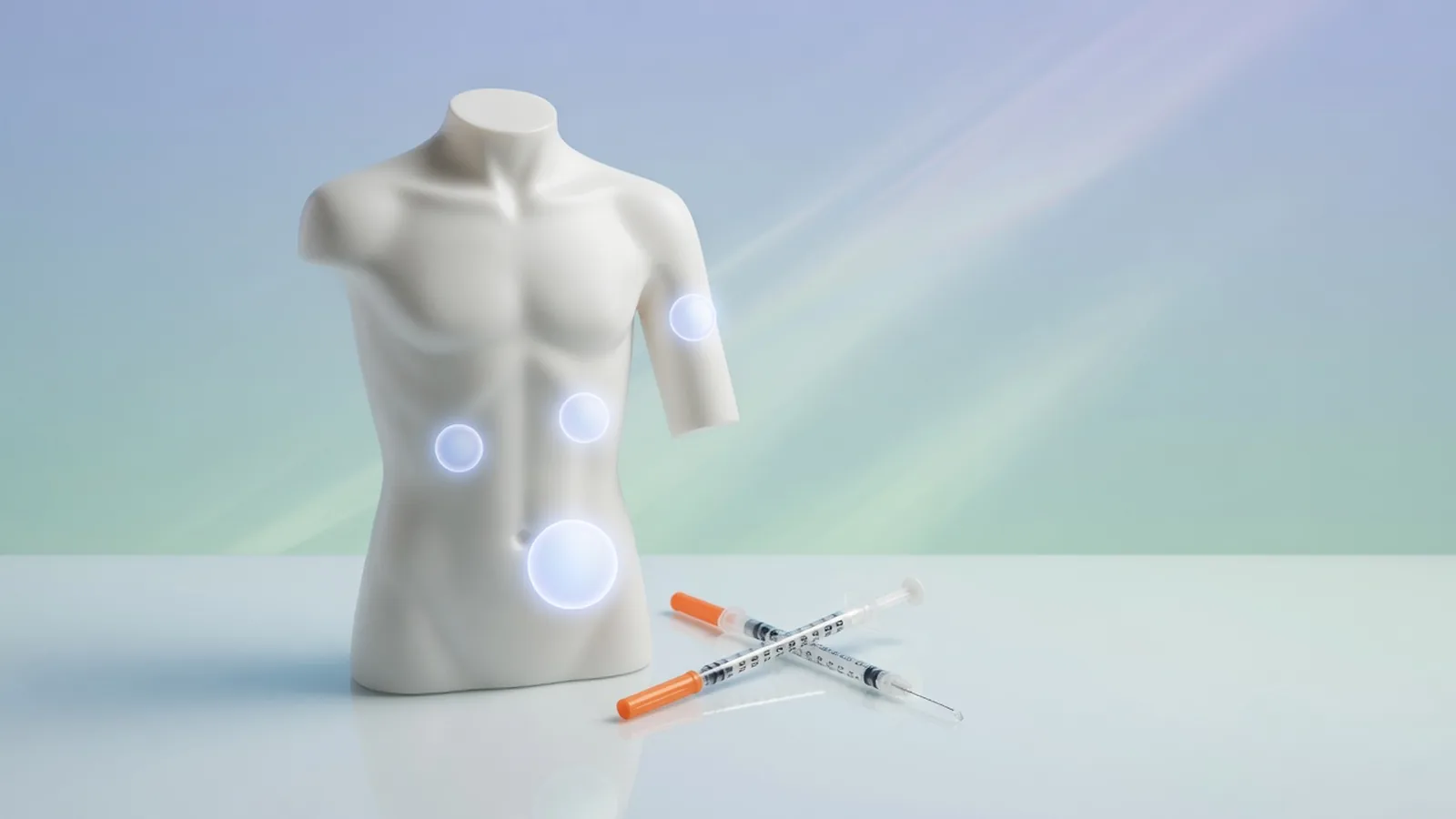
The standard peptide injection sites are the three subcutaneous areas that approved peptide labels name: the abdomen (at least 2 inches from the belly button), the front of the thigh, and the back of the upper arm. Ozempic and Mounjaro list all three, Vyleesi lists abdomen and thigh only, and Egrifta SV lists the abdomen only, so the right answer for an approved drug is whatever its own label says. Whichever area you use, the instructions consistently call for a new spot every time and for avoiding scarred, bruised or hard skin.
This page sets out the label-specified sites side by side, how rotation works, what needle length and angle the instructions describe for pens and insulin syringes, and what can honestly be said about sites for compounds with no label, including sermorelin, TB-500, CJC-1295, AOD-9604 and PT-141. It is reference information drawn from FDA labeling and injection-technique guidance, not personal medical advice. For what injectable peptides are in the first place, start with peptide injections.
Injection sites named in approved peptide labels
Each approved product's Instructions for Use defines its own sites. They overlap, but they are not identical, and the differences are deliberate.
| Product (peptide) | Route | Sites per label | Notable instruction |
|---|---|---|---|
| Ozempic (semaglutide) | Subcutaneous | Abdomen, thigh, upper arm | Do not inject into a muscle or vein; rotate with each injection |
| Mounjaro (tirzepatide) | Subcutaneous | Abdomen or thigh; back of upper arm by another person | Abdomen at least 2 inches from the belly button |
| Egrifta SV (tesamorelin) | Subcutaneous | Abdomen only | At least 2 inches (5 cm) from the belly button; not into scar tissue, bruises or the navel |
| Vyleesi (bremelanotide, research name PT-141) | Subcutaneous, autoinjector | Abdomen or front of thigh only | Avoid 2 inches around the navel; not through clothes |
| Miacalcin (calcitonin salmon) | Subcutaneous or intramuscular | Route specified rather than a site map | Over 2 mL: intramuscular preferred, split across sites |
For the GLP-1 drugs the choice among the three areas does not change how much drug reaches the bloodstream: both the Ozempic and Mounjaro labels state that similar exposure is achieved in the abdomen, thigh or upper arm. The Vyleesi label likewise reports that abdomen versus thigh had no significant effect on systemic exposure. Site choice is about comfort, reach and skin health, not potency.
Abdomen, thigh and upper arm: site by site
Abdomen
The most-used site and the only one on the Egrifta SV label. The labels that mention the navel put a 2-inch (5 cm) exclusion zone around it. That leaves a wide band of skin on either side and below, which makes the abdomen the easiest area to rotate within.
Thigh
The Vyleesi instructions specify the front of the thigh. It is easy to see and reach yourself, which is why both self-injection labels that restrict sites still include it.
Back of the upper arm
Ozempic lists the upper arm; the Mounjaro and Ozempic syringe instructions specify that the back of the upper arm should be injected by another person. It is hard to pinch a skin fold and hold an angle there one-handed.
Where not to inject
- Within 2 inches of the belly button
- Scar tissue, bruises, or skin that is irritated, sore, red or hard
- Areas with lumps from previous injections
- Through clothing
- Into a muscle or vein when the label says subcutaneous
How to rotate peptide injection sites
Every label on this page tells patients to rotate. The Mounjaro instructions add the useful detail: you may use the same area of the body each week, but choose a different spot within it, to reduce the risk of lipodystrophy (pits or thickened skin) and localized cutaneous amyloidosis. Egrifta SV ties rotation to injection-site reactions, which occurred in 25% of patients in its trials versus 14% on placebo.
The FITTER injection-technique recommendations explain why this matters beyond comfort: lipohypertrophy is a frequent complication of repeated injection, it distorts absorption, and injections should not be given into these lesions. Correct rotation helps prevent them.
| Dosing frequency | A simple rotation pattern |
|---|---|
| Once weekly (semaglutide, tirzepatide) | Alternate area each week (left abdomen, right abdomen, left thigh, right thigh) and move at least a finger-width from the last spot within an area |
| Once daily (tesamorelin) | Divide the abdomen into four quadrants outside the navel zone; use one quadrant per week and a new spot each day within it |
| As needed (bremelanotide) | Alternate abdomen and thigh; the label requires a different site each time |
If you also inject insulin, the Ozempic and Mounjaro labels allow both in the same body area, but not right next to each other, and never mixed in the same injection.
Needle length and angle for pens and insulin syringes
The aim of a subcutaneous injection is to land in fat, not muscle. FITTER's headline recommendation is that the shortest needles, the 4 mm pen needle and the 6 mm syringe needle, are safe, effective, less painful and should be the first-line choice in all patient categories. The labels then specify angle and pinch for their own devices.
| Device | Needle (per label) | Angle | Pinch a skin fold? |
|---|---|---|---|
| Ozempic pen | NovoFine Plus 32G, 4 mm (new needle each time) | "As your healthcare provider has shown you" | Not specified; hold the dose button until the counter reads 0 |
| Ozempic single-dose pre-filled syringe | Single-use syringe | 45 degrees | Yes, hold the pinch throughout |
| Egrifta SV vial and syringe | ½-inch 30-gauge, on a 1 mL syringe | 90 degrees, quick dart-like motion | Yes, release after the needle is in |
| Mounjaro single-dose pen | Built in | Clear base placed flat against the skin | Not specified; press and hold up to 10 seconds |
| Mounjaro vial and syringe | 1 mL syringe able to measure 0.5 or 0.6 mL | As shown by the prescriber | Prescriber decides |
The pattern is consistent: a longer needle (like the ½-inch Egrifta needle) is used with a pinched fold so it stays out of muscle; the Ozempic syringe uses a 45-degree angle into a pinch for the same reason. Reading the dose on the barrel is a separate skill, covered in the syringe measurement guide. To turn a milligram dose into the units you draw, use the mg to mL converter.
Step by step: a subcutaneous peptide injection
This is the common sequence across the Ozempic, Mounjaro, Egrifta SV and Vyleesi instructions. Where your product's own Instructions for Use differ, follow those.
- Wash your hands with soap and water.
- Check the product, dose and (for a vial) that the solution is clear.
- Choose a site from the ones your label allows, a new spot from last time.
- Clean the site with an alcohol pad and let it dry.
- Pinch a skin fold if your device's instructions call for it.
- Insert the needle at the angle your instructions give (for example 45 degrees for the Ozempic syringe, 90 degrees for the Egrifta SV needle).
- Push the plunger or button slowly and fully; hold as instructed.
- Withdraw the needle, do not recap it, and put it in a sharps container.
Never reuse or share a needle, syringe or pen, even with a new needle attached; the labels flag infection transmission as the reason.
Sermorelin injection sites
Sermorelin has no current US label to consult. It was approved as Geref (sermorelin acetate, EMD Serono, 1997) and is now listed as discontinued, with FDA noting it was not withdrawn for safety or effectiveness reasons. Today it is supplied mainly through compounding pharmacies, which do not issue FDA-approved instructions.
The closest approved reference is another GHRH analogue, tesamorelin, whose Egrifta SV label specifies subcutaneous injection into the abdomen only, rotated across the abdomen and kept 2 inches from the navel. That is a useful analogy for technique, not a label for sermorelin. A prescriber who compounds sermorelin should specify the site and technique. Dose arithmetic is on the sermorelin dosage page and the sermorelin calculator.
PT-141, TB-500, CJC-1295 and AOD-9604 injection sites
PT-141 injection site
PT-141 is bremelanotide, so it is the one research name here with a real label. Vyleesi is injected subcutaneously into the abdomen or the front of the thigh only, avoiding 2 inches around the navel, at least 45 minutes before anticipated sexual activity. See PT-141 dosage for women for the label dose and limits.
TB-500 injection site
There is no label. Online advice often says to inject TB-500 near an injury. Nothing in an approved label supports that, and FDA's compounding review states it has not identified any human exposure data for products containing the thymosin beta-4 fragment sold as TB-500. More on the TB-500 dosage page.
CJC-1295 injection site
No label either. FDA's compounding review notes serious adverse events associated with CJC-1295, including increased heart rate and a systemic vasodilatory reaction, and says available clinical data are limited. See CJC-1295 dosage.
AOD-9604 injection site
FDA's review says it has no, or only limited, safety information for AOD-9604, so there is no basis for a site recommendation beyond general subcutaneous technique.
For all three research compounds, the honest summary is that site guidance online is borrowed from the approved labels above. Choosing the abdomen or thigh and rotating is reasonable technique; it does not make an unapproved compound safer.
Calcitonin subcutaneous injection sites
Calcitonin salmon (Miacalcin) is one of the older peptide drugs and one of the few that allows two routes: subcutaneous or intramuscular. The label sets the route by volume rather than providing a body map: if the volume exceeds 2 mL, intramuscular injection is preferable and the dose should be spread across multiple sites. Local inflammatory reactions at the injection site were reported in about 10% of patients. The label also tells patients to use sterile technique and dispose of needles properly. Where to place a subcutaneous dose is something the prescriber or pharmacist should show you for this product.
Frequently Asked Questions
Where is the best place to inject peptides?expand_more
For an approved drug, wherever its label says. Ozempic and Mounjaro allow abdomen, thigh and upper arm; Vyleesi allows abdomen or thigh; Egrifta SV allows the abdomen only. The labels for Ozempic, Mounjaro and Vyleesi report similar drug exposure across their permitted sites.
How far from the belly button should I inject?expand_more
At least 2 inches (5 cm). The Mounjaro, Egrifta SV and Vyleesi instructions all specify that distance, and Egrifta SV says not to inject into the navel itself.
Do I need to rotate injection sites?expand_more
Yes. Every label here says to rotate. Repeated injection into one spot can cause lipohypertrophy or lipodystrophy, which distorts absorption, and site reactions.
Should I inject at 45 or 90 degrees?expand_more
Follow your device. The Ozempic pre-filled syringe uses 45 degrees into a pinched fold; the Egrifta SV half-inch needle uses 90 degrees into a pinched fold. For pens, the Ozempic instructions defer to how your healthcare provider showed you, and the Mounjaro pen is placed flat against the skin.
Where do you inject sermorelin?expand_more
There is no current US label for sermorelin. The approved GHRH analogue tesamorelin is injected subcutaneously into the abdomen, which is a technique reference, not a sermorelin instruction. Your prescriber should specify the site.
Can I inject peptides into muscle?expand_more
Not when the label says subcutaneous. The Ozempic Medication Guide explicitly says not to inject into a muscle. Miacalcin is an exception that allows intramuscular use.
References & Citations
- [1]
Ozempic (semaglutide) injection. US Prescribing Information, Medication Guide and Instructions for Use (pens and single-dose pre-filled syringes). Novo Nordisk; revised 01/2025, DailyMed version effective June 2026.View source →
- [2]
Mounjaro (tirzepatide) injection. US Prescribing Information, Medication Guide and Instructions for Use (pen, KwikPen, single- and multiple-dose vials). Eli Lilly; revised 08/2026.View source →
- [3]
Egrifta SV (tesamorelin) for injection. US Prescribing Information, Patient Information and Instructions for Use. Theratechnologies; revised 03/2024.View source →
- [4]
Vyleesi (bremelanotide injection). US Prescribing Information and Instructions for Use. Cosette Pharmaceuticals; revised 03/2024.View source →
- [5]
Miacalcin (calcitonin salmon) injection, for subcutaneous or intramuscular use. US Prescribing Information. Mylan Institutional; DailyMed version 09/2024.View source →
- [6]
Frid AH, Kreugel G, Grassi G, et al. New Insulin Delivery Recommendations (Forum for Injection Technique and Therapy: Expert Recommendations, FITTER). Mayo Clin Proc. 2016;91(9):1231-1255.View source →
- [7]
US FDA. Certain Bulk Drug Substances for Use in Compounding that May Present Significant Safety Risks. Content current as of 04/22/2026.View source →
- [8]
Drugs@FDA. Geref (sermorelin acetate), NDA 020443, EMD Serono; approved 09/26/1997, marketing status Discontinued.View source →