Victoza Dosage: 0.6 to 1.8 mg Chart, Max Dose and Weight Loss
Victoza dosage from the FDA label: 0.6 mg daily for a week, then 1.2 mg, and a 1.8 mg daily maximum. Why it is not a weight-loss dose, and where Saxenda fits.
MEDICAL DISCLAIMER: Educational research guidelines only. Lyophilized peptides are investigational chemical compounds and are NOT approved for human consumption, diagnosis, or therapy. Consult a licensed physician before any research application.
Victoza dosage follows a three-step label ladder: 0.6 mg injected once daily for one week, then 1.2 mg once daily, and, if more glucose control is needed after at least a week at 1.2 mg, the maximum of 1.8 mg once daily. The 0.6 mg step exists only to reduce stomach side effects and does not control blood sugar in adults. Victoza is approved for type 2 diabetes (adults and children aged 10 and older) and for cardiovascular risk reduction, not for weight loss; the same molecule, liraglutide, is labelled for weight management as Saxenda at up to 3 mg daily.
Everything below comes from the current US prescribing information for Victoza (revised 10/2025). It is reference information, not a dosing plan: the prescriber decides whether and when to move up a step.
Victoza dosage chart: the label ladder
Victoza is a once-daily subcutaneous injection, given at any time of day with or without meals, in the abdomen, thigh or upper arm. The pen delivers only three doses, so the chart is short.
| Step | Daily dose (adults) | Minimum time at step | What the label says about it |
|---|---|---|---|
| Start | 0.6 mg | 1 week | Titration only. Intended to reduce gastrointestinal reactions; not effective for glycemic control in adults. |
| Standard | 1.2 mg | At least 1 week before any further increase | First dose that counts as treatment. |
| Maximum | 1.8 mg | Ongoing | Only if additional glycemic control is required. This is the maximum recommended dosage. |
Children aged 10 and older follow the same three doses with a softer timetable: start at 0.6 mg, and increase in 0.6 mg steps only if more glucose control is needed, after at least one week on the current dose. The pediatric maximum is also 1.8 mg once daily. The compound-level numbers, including half-life, are on the liraglutide dosage page. For how this ladder compares with weekly drugs such as semaglutide and tirzepatide, the GLP-1 medications guide sets the ladders side by side.
Victoza starting dose: why 0.6 mg does not count
The Victoza starting dose is 0.6 mg once daily for one week. The label is unusually blunt about it: this dose is there to let the gut adapt and "is not effective for glycemic control in adults". Someone who stays on 0.6 mg for weeks is, by the label's own wording, not yet on a treatment dose.
The reason for the slow start is the same across the whole class. GLP-1 receptor activity slows gastric emptying and causes nausea, and both effects are dose related and fade with steady exposure. One week at 0.6 mg before 1.2 mg makes for a short ladder; Saxenda, the weight-management liraglutide, takes four weeks to reach its maintenance dose because it climbs much higher.
Victoza maximum dose: 1.8 mg once daily
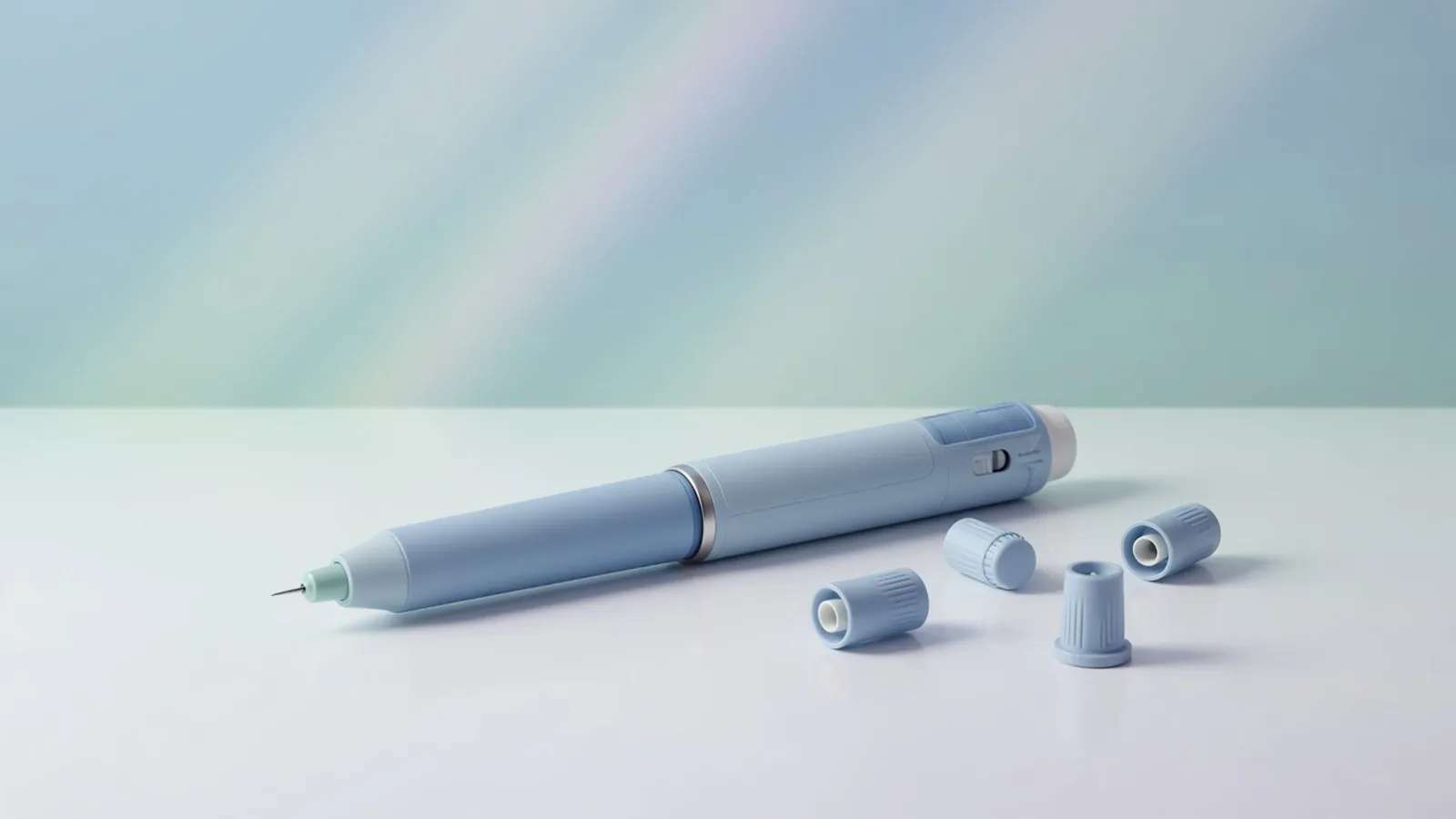
The Victoza max dose is 1.8 mg injected once daily, for adults and for children aged 10 and older. The label calls it "the maximum recommended dosage", and the pen cannot dial anything higher: its dose selector stops at 0.6 mg, 1.2 mg and 1.8 mg.
Moving from 1.2 mg to 1.8 mg is conditional, not automatic. The label adds the increase only "if additional glycemic control is required" and only after at least one week at 1.2 mg. In the 52-week monotherapy trial described in the label, HbA1c fell by 1.1 points on 1.8 mg and 0.8 points on 1.2 mg, so the top step buys a real but modest extra effect.
No dose adjustment is recommended for kidney or liver impairment, although the label urges caution with liver impairment and monitoring of kidney function if vomiting or diarrhoea causes dehydration. The risk that does change the picture is low blood sugar: when Victoza is added to insulin or a sulfonylurea, the label notes that those doses may need reducing.
Victoza dosage for weight loss: what the label does and does not say
There is no Victoza dosage for weight loss on the label, because Victoza is not approved for weight loss. Its indications are blood sugar control in type 2 diabetes and reducing major cardiovascular events in adults with type 2 diabetes and established heart disease, the second resting on the LEADER outcomes trial.
Weight does fall in the diabetes trials, which is where the search comes from. In the label's 52-week monotherapy trial, body weight changed by -2.5 kg on 1.8 mg and -2.1 kg on 1.2 mg, against +1.1 kg on glimepiride. In the SCALE Diabetes trial, adults with type 2 diabetes and overweight or obesity lost 4.7% of body weight on liraglutide 1.8 mg and 6.0% on 3.0 mg over 56 weeks, versus 2.0% on placebo.
That gap is why a separate product exists. Liraglutide for chronic weight management is sold as Saxenda, which escalates to 3 mg daily; the Saxenda dosage guide covers its five-week schedule, missed-dose rule and stopping criteria. So the maximum dose of Victoza for weight loss is not a meaningful number: the Victoza ceiling is 1.8 mg for diabetes, and the weight-management ceiling of 3 mg belongs to a different label.
Two practical warnings follow from the labels. Victoza states that coadministration with other liraglutide-containing products is not recommended, so Victoza and Saxenda are not used together. And neither pen is a substitute for the other: the Victoza pen cannot deliver 2.4 mg or 3 mg, and the label gives no switching schedule between them. That decision belongs to the prescriber. For the wider picture of injectable weight-management drugs and their schedules, see the weight loss injections guide.
Victoza 18 mg/3 mL pen: volume and doses per pen
Each Victoza pen holds 18 mg of liraglutide in 3 mL, a concentration of 6 mg/mL. The pen measures the dose for you, so there is nothing to convert, but the arithmetic explains how long a pen lasts.
| Dose | Volume delivered | Maximum full doses in one 18 mg pen (arithmetic) |
|---|---|---|
| 0.6 mg | 0.1 mL | 30 |
| 1.2 mg | 0.2 mL | 15 |
| 1.8 mg | 0.3 mL | 10 |
The last column is a ceiling, not a promise. Each new pen needs a one-time flow check, and the label says a pen in use must be thrown away 30 days after first use even if solution remains. Unused pens are refrigerated at 2 to 8 °C and must not be frozen; once in use, a pen can be kept at room temperature (15 to 30 °C) or in the fridge for those 30 days. The label lists cartons of two and three pens.
Victoza missed dose rule
The label's missed-dose rule is simple and matters more than it looks:
- One missed dose: take the next scheduled dose as normal. Do not take an extra dose or a larger dose to make up for it.
- More than 3 days since the last dose: restart at 0.6 mg once daily to reduce the risk of gastrointestinal reactions on restarting. The prescriber then decides how quickly to climb back.
The three-day rule exists because tolerance to the gut effects fades quickly with a daily drug. Restarting straight at 1.8 mg after a long gap is the scenario the rule is written to prevent.
Compounded liraglutide and syringe units
Victoza is a branded, FDA-approved pen. Liraglutide supplied in a vial for drawing with an insulin syringe is a different product: it is not Victoza, it has not been through the same approval, and a unit count is only meaningful once the concentration is known. The formula is:
Units on a U-100 syringe = dose in mg ÷ (vial mg ÷ mL of water) × 100
EXAMPLE concentration only: a 10 mg vial mixed with 2 mL gives 5 mg/mL. At that concentration 0.6 mg is 12 units, 1.2 mg is 24 units and 1.8 mg is 36 units. At any other concentration every number changes, which is why a unit count copied without its concentration is unsafe. Run your own numbers in the liraglutide calculator or the mg to mL and units converter, and see the syringe measurement guide for reading the barrel.
Frequently Asked Questions
What is the starting dose of Victoza?expand_more
0.6 mg injected under the skin once daily for one week. The label states this dose is only for reducing stomach side effects and is not effective for blood sugar control in adults, so it is followed by 1.2 mg daily.
What is the maximum dose of Victoza?expand_more
1.8 mg once daily, for adults and for children aged 10 and older. It is added only if more blood sugar control is needed after at least one week at 1.2 mg, and the pen cannot dial a higher dose.
Can Victoza be used for weight loss?expand_more
Victoza is not FDA-approved for weight loss. Weight fell modestly in its diabetes trials, but the liraglutide product labelled for chronic weight management is Saxenda, which escalates to 3 mg daily. The Victoza label also advises against using it with other liraglutide products.
How many doses are in an 18 mg/3 mL Victoza pen?expand_more
By arithmetic, up to 30 doses of 0.6 mg, 15 of 1.2 mg or 10 of 1.8 mg. In practice the first-use flow check takes a little, and the label requires discarding a pen 30 days after first use.
What if I miss a dose of Victoza?expand_more
Per the label, skip it and take the next scheduled dose; do not double up. If more than 3 days have passed since the last dose, Victoza is restarted at 0.6 mg daily and the prescriber decides how to titrate back up.
Is Victoza the same as Saxenda?expand_more
Both contain liraglutide at 6 mg/mL in an 18 mg pen, but they are different products with different labels. Victoza is for type 2 diabetes with a 1.8 mg maximum; Saxenda is for weight management with a 3 mg maintenance dose.
References & Citations
- [1]
Victoza (liraglutide) injection, for subcutaneous use. US Prescribing Information, Novo Nordisk, revised 10/2025 (DailyMed, published November 2025). Sections 1, 2.1, 2.2, 3, 8.6, 8.7, 14.1 and 16.View source →
- [2]
Saxenda (liraglutide) injection, for subcutaneous use. US Prescribing Information, Novo Nordisk, revised 02/2026 (DailyMed). Indication and 3 mg maintenance dose.View source →
- [3]
Davies MJ, Bergenstal R, Bode B, et al. Efficacy of Liraglutide for Weight Loss Among Patients With Type 2 Diabetes: The SCALE Diabetes Randomized Clinical Trial. JAMA. 2015;314(7):687-699.View source →
- [4]
Marso SP, Daniels GH, Brown-Frandsen K, et al. Liraglutide and Cardiovascular Outcomes in Type 2 Diabetes (LEADER). N Engl J Med. 2016;375(4):311-322.View source →